by Deren Hansen
We often talk of all the gatekeepers we have to get past in order to get published. We even say things like, “vetted by publishers”—as if publishers where somehow the guardians of all that is good and true. Unfortunately our sloppy language leads to sloppy thinking about the role of publishers. Specifically, we confuse gatekeeping with advocacy.
Gatekeeping means choosing who will pass and who will be excluded. It also implies an endorsement: if the bouncer at the club lets you past the velvet rope you know you're one of the cool people.
Advocacy is an important element in maintaining the social fabric. Obvious self-interest makes us wary of both the promoter and the product. But if a nominally disinterested party champions someone’s cause, we take it as evidence the case has merit. That’s why we need lawyers and agents.
Publishers provide advocacy through investment. Talk is cheap. Backing up that talk by investing a substantial sum in a book says something. Of course there’s no direct correlation between the amount invested and the quality of the book. But assuming publishers are rational economic actors, if the publisher is willing to bet so much on a project, perhaps it’s worth our attention too.
Publishers are not pure advocates because they have a financial interest in the sale of the book. To compensate, the industry has developed layers of structural advocates. From the wholesaler, distributor, and retailer model of the distribution chain to the web of reviewers, booksellers, librarians, and teachers who promote books and reading in general, the publishing industry, which is just as commercial as any other, manages to come out looking like a cultural institution.
The new world of frictionless, costless e-publishing doesn’t change the need for advocacy. You may be able to establish a reputation by building an online social network. You may inspire readers to recommend your work. Regardless of the expression, the underlying pattern remains the same: to be credible you need independent third parties willing to expend their own time and resources to vouch for your work.
One of the few things you can’t do as an artisan publisher is be your own advocate. Clearly you must put a great deal of time and effort into promoting your work. But no matter how much effort you put into it, marketing can never become advocacy because you’re not an independent party.
If your artisan publishing effort expands to include other authors, you can become an advocate for their work to a small degree. But compared to the major publishing houses that have the financial wherewithal to lavish seven-figure advances on celebrities your own investment will hardly stand out.
The practical upshot is that in order to succeed as an artisan publisher you must nurture a network of independent advocates without any of the structural advantages enjoyed by large publishing companies. Moreover, you will have to compete with those companies for readers’ attention every step of the way. The only way to build credibility and to attract advocates is to keep showing up: to consistently deliver high quality content. You need to be prepared for a slow, patient game.
Deren Hansen is the author of the Dunlith Hill Writers Guides. Learn more at dunlithhill.com.
Wednesday, October 24, 2012
Monday, October 22, 2012
There's No Crying in Writing
By Julie Daines
I'm sharing just a quick writing tip today that I got from award winning author Martine Leavitt.
She states that one of the rules of writing for MG and YA is that your main character can only cry once in the whole manuscript. Maybe twice--if the situation really warrants it.
Why? Tears are like swear words in writing, less is more. Tears tend to jump out of the page and draw excess attention to themselves. It only takes one or two well placed shedding of tears to punctuate the story, any more and it starts to feel like an overused physical cliche.
I've been reading a lot of YA books this fall, and I've seen a lot of weepy main characters. I've come to the conclusion that I agree with Martine.
So before your main character swipes at her eyes, dashes away salty drops, buries her head in her pillow and weeps, or collapses on the floor in sobs, make sure you've carefully chosen the one exact moment when those tears will mean the most.
Any other quick tips you can think of?
See my post on Fall, Shakespeare, Life and Death at juliedaines.blogspot.com
I'm sharing just a quick writing tip today that I got from award winning author Martine Leavitt.
She states that one of the rules of writing for MG and YA is that your main character can only cry once in the whole manuscript. Maybe twice--if the situation really warrants it.
Why? Tears are like swear words in writing, less is more. Tears tend to jump out of the page and draw excess attention to themselves. It only takes one or two well placed shedding of tears to punctuate the story, any more and it starts to feel like an overused physical cliche.
I've been reading a lot of YA books this fall, and I've seen a lot of weepy main characters. I've come to the conclusion that I agree with Martine.
So before your main character swipes at her eyes, dashes away salty drops, buries her head in her pillow and weeps, or collapses on the floor in sobs, make sure you've carefully chosen the one exact moment when those tears will mean the most.
Any other quick tips you can think of?
See my post on Fall, Shakespeare, Life and Death at juliedaines.blogspot.com
Sunday, October 21, 2012
Writing a Book Series with Award-winning Author Kai Strand
One question I'm asked a lot by beginning writers or readers of children's or YA is do I write series. Over the years it seems more and more authors are writing series be it a children's picture book or young adult novel.
I believe there are a few reasons why this is happening. The first and most common reason is because the main storyline/plot is too big to wrap up in one book with enough details being shared with the reader. The second reason is some characters in picture books to young adult novels are so beloved the author keeps finding new situations and plots for their main character.
This is why I asked friend and award-winning author Kai Strand to share her thoughts on writing a book series.
Saturday, October 20, 2012
Character questions
So I’ve been living with these people for two years now, but
do I really know my characters?
I believe I should know them, but I’m not sure I do. Are
they real? Are they kid-like? Do they stay true to themselves? Are they complex
enough?
Kathleen Duey has a
few ideas about characters. She taught at WIFYR a couple of years ago. I
debated joining her workshop but didn’t. I was totally pleased to be with
Claudia Mills. I did attend one of Kathleen’s afternoon sessions. Then I went
to a second one. She’s an amazing writer and so willing to share her expertise
of the craft.
Kathleen’s suggests interviewing your characters, to ask
them questions.
Back then, I had just found my characters and her questions
helped me locate them. As I put the finishing touches on the revision, I recently
revisited those questions and am asking them again. It is interesting to see
how my characters have grown. So it is a good exercise to do no matter what
stage your project is in.
Kathleen says to ask your MC things like what do they want
most in life and what is in the way of them getting it? You can ask questions
in general or you can ask the characters directly. For example, why do you want
to be in my book? Can my story live without you?
On her Throwing Up Words blog, Carol Lynch Williams also had
some questions that you could ask your characters. Why are you the main
character of my story? What if I were to make one of the other ones the main
character and you a minor character? Carol lists some questions you can ask
yourself about them: Are their actions coming naturally out of the story or are
you making things happen the way you think they should because you thought you
had an end in mind and the book has changed directions? (That last one is a
thinker.) Why does your character say what she says? Is this her? Or is this
you? Carol says to make her real, not an older person. This is especially true
if you’re writing children’s fiction. Other questions to ask: What made
your character do what she just did? Was that natural to the story or are you
forcing things around?
Dr. Suzanna Henshon suggests asking how the main character’s
personality impacts the plot. How do the plot and the main characters conjoin?
Hopefully the main people in my story improve, as does the
story itself.
Friday, October 19, 2012
Is they is, or is they are?
by Scott Rhoades
A few days ago, one of my friends asked the following on Facebook:
How would you properly say, "If you or your child are (is)....?"
The simple answer is that you go with the verb form that applies to the noun or pronoun nearest the verb. You are, but your child is, so you use is. But it's one of those things where, even if you know the rule, if you look at it long enough you might start to question it.
The or makes it singular. If you used and, the verb would be are, because you and your child become a plural noun phrase.
Let's try a similar sentence, in the spirit of the current season:
If your son or his parakeet is being eaten by ravenous leeches...
The answer verb is still is, but I'll bet this one made some of you wonder. Throw in an are and I'll bet at least a few of you will feel less sure about the correct verb, especially if you read it out loud.
On the other hand:
If your son or his parakeets are being dissolved by the globulous acid monster...
Order matters. If you put the kid first, you'd get:
If your child or you are going to dig up the bodies in the back yard for dinner...
This next example is where it starts to feel tricky:
If your sons or their guppy is being gulped down by toothless witch babies...
It's easy to question the simple noun-closest-to-the-verb explanation here. It feels wrong, because one of the subjects is plural. As it turns out, it actually is wrong, at least according to some grammarians, although leniency is often granted in a case like this. Or maybe the way to look at it is both ways are right. Ish. As we all know, any rule has exceptions. According to many grammarians, the closest-noun rule does not apply if either of the subject nouns is plural. Whether I use is or are, it doesn't feel more right than if I use the other. This is a case where I would rewrite the sentence because even the right verb form has an incorrect feel to it. But that's not easy in this example. If I had written:
If your sons or the guppy is being gulped down by toothless witch babies...
I'd switch the nouns around, putting the plural closest to the verb, which makes it feel better:
If the guppy or your sons are being gulped down by toothless witch babies...
However, that ownership-showing their might be important in the sentence. In that case, you're either going to offend the a-plural-in-either-position-requires-are crowd or the closest-to-the-verb gang. I would look for a way to rewrite surrounding sentences that allows you to choose a less contentious construct.
Whenever you are faced with a problem like this, read it aloud. As a writer, you most likely have a good feel for the language and so you can usually rely on the feel of the sentence, on your instinct. If you're still not sure, look it up. However, if a problem feels that sticky, it usually means that rewriting should be considered. Even if you wrote it correctly, a sentence that requires a tricky grammar rule is likely to feel wrong or confusing to some readers, which will pull them out of your story, even if only for a second. You don't want to do that, so opt for a construct that flows naturally and is clear and easily understood without requiring the reader to think about grammar, and without creating a speed bump that interrupts the flow of the story.
A few days ago, one of my friends asked the following on Facebook:
How would you properly say, "If you or your child are (is)....?"
The simple answer is that you go with the verb form that applies to the noun or pronoun nearest the verb. You are, but your child is, so you use is. But it's one of those things where, even if you know the rule, if you look at it long enough you might start to question it.
The or makes it singular. If you used and, the verb would be are, because you and your child become a plural noun phrase.
Let's try a similar sentence, in the spirit of the current season:
If your son or his parakeet is being eaten by ravenous leeches...
The answer verb is still is, but I'll bet this one made some of you wonder. Throw in an are and I'll bet at least a few of you will feel less sure about the correct verb, especially if you read it out loud.
On the other hand:
If your son or his parakeets are being dissolved by the globulous acid monster...
Order matters. If you put the kid first, you'd get:
If your child or you are going to dig up the bodies in the back yard for dinner...
This next example is where it starts to feel tricky:
If your sons or their guppy is being gulped down by toothless witch babies...
It's easy to question the simple noun-closest-to-the-verb explanation here. It feels wrong, because one of the subjects is plural. As it turns out, it actually is wrong, at least according to some grammarians, although leniency is often granted in a case like this. Or maybe the way to look at it is both ways are right. Ish. As we all know, any rule has exceptions. According to many grammarians, the closest-noun rule does not apply if either of the subject nouns is plural. Whether I use is or are, it doesn't feel more right than if I use the other. This is a case where I would rewrite the sentence because even the right verb form has an incorrect feel to it. But that's not easy in this example. If I had written:
If your sons or the guppy is being gulped down by toothless witch babies...
I'd switch the nouns around, putting the plural closest to the verb, which makes it feel better:
If the guppy or your sons are being gulped down by toothless witch babies...
However, that ownership-showing their might be important in the sentence. In that case, you're either going to offend the a-plural-in-either-position-requires-are crowd or the closest-to-the-verb gang. I would look for a way to rewrite surrounding sentences that allows you to choose a less contentious construct.
Whenever you are faced with a problem like this, read it aloud. As a writer, you most likely have a good feel for the language and so you can usually rely on the feel of the sentence, on your instinct. If you're still not sure, look it up. However, if a problem feels that sticky, it usually means that rewriting should be considered. Even if you wrote it correctly, a sentence that requires a tricky grammar rule is likely to feel wrong or confusing to some readers, which will pull them out of your story, even if only for a second. You don't want to do that, so opt for a construct that flows naturally and is clear and easily understood without requiring the reader to think about grammar, and without creating a speed bump that interrupts the flow of the story.
Thursday, October 18, 2012
A Commitment to Life
In my ever growing stack of books on my nightstand, I have a precious volume of WRITING THE BREAKOUT NOVEL, by Donald Mass. Among all the wonderful advise that just seeps from this book, the one that I have been thinking about a lot these days is about how "to catch the mood of our times." In other words, he talks about how to give our story a dosis of reality so that the reader, whoever our intended audience may be, can identify with our characters so much, the characters' stakes become the readers' stakes. Isn't this a wonderful concept? In what ways does the outcome of a story affect our lives so much?
In his book, Donal Mass estates that "to write about life, you must live it." Also that "writing the breakout novel demands a commitment to life... take your stakes from life, and they will resonate like a temple gong."
In the different writers' workshops I've attended through the years, I've often heard similar advice: have other interests besides writing, take a dance/drawing/Zumba/skydiving class, have fun with friends, take yourself on an artist date, read outside of the genre you usually read/write, enjoy nature.
There's a scene in the Little Women movie, that perfectly illustrates this concept. Following her dream of becoming a an author, Jo has written a book she's super anxious for Mr Bhaer to read. The next day she wants to hear his opinion, probably imagining his lavish praise of the book she worked so hard on. If Mr Bhaer has an attribute, that attribute is honesty. He says that he didn't feel the book came from her heart. He goes on to say, "write about life, write from your heart."
In the movie, Jo applies his advice (after some heartfelt tears, of course) and writes the story she was always meant to write.
It doesn't mean we should all write memoirs about our lives, that there's no room for fantasy or science fiction. There wouldn't be Harry Potter, Narnia, or Avatar! Instead, it means that to make our stories come alive, we, the storyteller, the wordsmith, must know that it is that feels like life. Draw from our experiences and infuse the essence of emotions in our words.
What books have you read in which the stakes have been so high and real that you saw yourself in the story? What books resonate with you so much they feel like "real life"even though they are fiction?
In his book, Donal Mass estates that "to write about life, you must live it." Also that "writing the breakout novel demands a commitment to life... take your stakes from life, and they will resonate like a temple gong."
In the different writers' workshops I've attended through the years, I've often heard similar advice: have other interests besides writing, take a dance/drawing/Zumba/skydiving class, have fun with friends, take yourself on an artist date, read outside of the genre you usually read/write, enjoy nature.
There's a scene in the Little Women movie, that perfectly illustrates this concept. Following her dream of becoming a an author, Jo has written a book she's super anxious for Mr Bhaer to read. The next day she wants to hear his opinion, probably imagining his lavish praise of the book she worked so hard on. If Mr Bhaer has an attribute, that attribute is honesty. He says that he didn't feel the book came from her heart. He goes on to say, "write about life, write from your heart."
In the movie, Jo applies his advice (after some heartfelt tears, of course) and writes the story she was always meant to write.
It doesn't mean we should all write memoirs about our lives, that there's no room for fantasy or science fiction. There wouldn't be Harry Potter, Narnia, or Avatar! Instead, it means that to make our stories come alive, we, the storyteller, the wordsmith, must know that it is that feels like life. Draw from our experiences and infuse the essence of emotions in our words.
What books have you read in which the stakes have been so high and real that you saw yourself in the story? What books resonate with you so much they feel like "real life"even though they are fiction?
Wednesday, October 17, 2012
Why the Traditional Separation between Authors and Publishers?
by Deren Hansen
The broad-brush functional differences between the right and left hemispheres of the brain have become a mainstay of pop psychology: the right brain is the seat of creativity while the left brain has a monopoly on detail work. Some people personify the two as the accountant and the artist in your head.
It's hard to say whether that simple dichotomy will stand the test of our growing understanding of neuroscience, but it is a useful way to characterize the traditional division of labor between author and publisher. It's easy to caricature the author as artist in contrast to—and sometimes in conflict with—the publisher as accountant and business manager.
As with all common notions, this analogy has a kernel of truth: authors provide the novel (in both senses of the word) content and publishers take care of all the details involved in preparing, packaging, and presenting that content in the marketplace.
Of course, the divide isn’t between creative and non-creative work. Writing involves plenty of drudgery and the best marketing is thoroughly creative. But there is an important distinction between the kinds of creativity and detail work that are most effective in the traditional roles of author and publisher. And now that many authors are expected to provide a substantial portion of the marketing effort they find they need to master an entirely different set of skills.
As challenging as it may be for an author with a traditional publishing arrangement to switch writing and marketing hats, self-publishing means that you have to wear both hats all the time. Put another way, whether you know it or not you’re signing up to bridge the traditional right brain/left brain split between authors and publishers in your own little head when you self-publish.
If you think that editing is an endless round of fiddly grammar details, wait till you're stuck trying to figure out why the formatting for your e-book is off on three devices but looks great everywhere else. Getting covers right requires attention to the art design, graphic file formats, scale and resolution for different platforms, and a host of conventions like including your ISBN as a barcode on the back cover and listing the book’s category. Then there are details like copyright statements, warranties, and metadata that all have to be both correct and correctly presented. Making sure all of these things right requires constant checking and double checking.
Setting aside whatever frustration with the old or fascination with the new that you may have, there are good reasons for the traditional division between producers and distributors in many areas of the economy. You need to understand both the reasons for and the substance of each role if you want to walk the path of the artisan publisher because you’re signing up for both jobs.
Deren Hansen is the author of the Dunlith Hill Writers Guides. Learn more at dunlithhill.com.
The broad-brush functional differences between the right and left hemispheres of the brain have become a mainstay of pop psychology: the right brain is the seat of creativity while the left brain has a monopoly on detail work. Some people personify the two as the accountant and the artist in your head.
It's hard to say whether that simple dichotomy will stand the test of our growing understanding of neuroscience, but it is a useful way to characterize the traditional division of labor between author and publisher. It's easy to caricature the author as artist in contrast to—and sometimes in conflict with—the publisher as accountant and business manager.
As with all common notions, this analogy has a kernel of truth: authors provide the novel (in both senses of the word) content and publishers take care of all the details involved in preparing, packaging, and presenting that content in the marketplace.
Of course, the divide isn’t between creative and non-creative work. Writing involves plenty of drudgery and the best marketing is thoroughly creative. But there is an important distinction between the kinds of creativity and detail work that are most effective in the traditional roles of author and publisher. And now that many authors are expected to provide a substantial portion of the marketing effort they find they need to master an entirely different set of skills.
As challenging as it may be for an author with a traditional publishing arrangement to switch writing and marketing hats, self-publishing means that you have to wear both hats all the time. Put another way, whether you know it or not you’re signing up to bridge the traditional right brain/left brain split between authors and publishers in your own little head when you self-publish.
If you think that editing is an endless round of fiddly grammar details, wait till you're stuck trying to figure out why the formatting for your e-book is off on three devices but looks great everywhere else. Getting covers right requires attention to the art design, graphic file formats, scale and resolution for different platforms, and a host of conventions like including your ISBN as a barcode on the back cover and listing the book’s category. Then there are details like copyright statements, warranties, and metadata that all have to be both correct and correctly presented. Making sure all of these things right requires constant checking and double checking.
Setting aside whatever frustration with the old or fascination with the new that you may have, there are good reasons for the traditional division between producers and distributors in many areas of the economy. You need to understand both the reasons for and the substance of each role if you want to walk the path of the artisan publisher because you’re signing up for both jobs.
Deren Hansen is the author of the Dunlith Hill Writers Guides. Learn more at dunlithhill.com.
Tuesday, October 16, 2012
Avoided Moments
Years ago I heard Richard Peck say, “You learn the most from
the experience you would have avoided if you could.” In the same keynote
address I also heard him say, “You are only as good as your opening line”. Although
the second quote is one of my favorite, that will have to be a discussion for
another post.
Think about the experience you would have avoided if you could. We all have things in our lives that fit this description. What emotion is connected to that experience? What would you have done to avoid it if we had known it was coming? Who would you be now, if that experience had not existed in your life?
Your character needs an experience like that. They need to
be faced with something so terrible or terrifying that they would have avoided
it at all cost. Maybe they are trying to avoid it. Perhaps they know, and
understand what is at stake.
How do we help our character find that experience? Is it
something we have experienced in our own lives and know about? Not always.
Maybe you are experiencing this situation for the first time through your
character and are trying to understand the emotions connected to this
experience.
I’ve been trying to create a character that is dominating
and has an entire community under his thumb. He would have to be so controlling
and scary that nobody dared cross him. The problem is, fortunately, I’ve never
experienced such dominion. However, as I’ve struggled with this character, I
realized that there are moments in my life when I was terrified of a situation
or person. Especially as a child. I’ve examined those experiences and the
emotions that go with them and tried to transfer them to this fictional
character that plays such a critical role in my novel.
Transferring these emotions does not mean transferring the
exact experience. But the emotions can help you to create this character and
give him real traits. You will better know how the characters around him will
react as you pull from these emotions and then interview your characters. All
your characters. How are they feeling? What are they thinking? How will that
cause them to react to the particular rough spot where you have led them? Monday, October 15, 2012
Do you have what it takes to be an author?
I went to Lisa Mangum's presentation at the UVU Book Academy. She talked about FOUR things you need to shine as a newbie author:
Vision
Passion
Flexibility
Endurance
Not what you expected, right? I'll expand.
Vision-Publishing is a business. Research your genre and the marketplace. Where do you see your book going and how is it going to get there? Do you have ideas for marketing your book? What is your platform?
Passion- Write every day. It makes you a better writer. Read. It makes you a better writer. Learn to self-edit and make every page better. You are a storyteller. Tell your story.
Flexibility- Publishing is a team effort. Trust your editor. Maintain balance in your life. Can you work creatively and market your book? Are you willing to publish digitally as well as traditionally? Can you live with a title or cover you don't love?
Endurance- Is your writing a hobby or career? Both are good choices. What are your goals? Can you write more than one book a yer? Can you meet your deadlines? Editors LOVE when writers meet their deadlines!
Vision
Passion
Flexibility
Endurance
Not what you expected, right? I'll expand.
Vision-Publishing is a business. Research your genre and the marketplace. Where do you see your book going and how is it going to get there? Do you have ideas for marketing your book? What is your platform?
Passion- Write every day. It makes you a better writer. Read. It makes you a better writer. Learn to self-edit and make every page better. You are a storyteller. Tell your story.
Flexibility- Publishing is a team effort. Trust your editor. Maintain balance in your life. Can you work creatively and market your book? Are you willing to publish digitally as well as traditionally? Can you live with a title or cover you don't love?
Endurance- Is your writing a hobby or career? Both are good choices. What are your goals? Can you write more than one book a yer? Can you meet your deadlines? Editors LOVE when writers meet their deadlines!
Patience + Persistence=Publication
Saturday, October 13, 2012
Plot
One of the writing sites I subscribe to had a recent article
about plot. This topic was pertinent as I am planning out my next story. Yet,
it is also relevant in putting the finishing touches on a piece I am revising.
A good book must have story. The author needs to take the
reader by the hand and lead them to a new world, a new reality. The main
character’s circumstance must be believable and the writing smooth. I want to
open a book, delve in, and become so absorbed by the story that my own living
room seems foreign a few hours later when I come out of the story.
Jane McBride Choate, in the Children’s Book Insider October
newsletter, describes plot as a summation of cause and effect. Often this is
referred to as sequence action & reaction. It is not merely a series of
events. The events must be connected to each other, with each new incident
building on the last. Each attempt the MC makes to solve his problem should
change something vital for him or her. Choate says every part of the story
should be an absolutely essential step along the way to the outcome. If a scene
does not belong in your story it should be removed. If its removal can be done
without altering the outcome of the story then it doesn’t belong in your story.
Choate advises the author to look at each event through the
MC’s eyes. Continually ask, “how does this make the MC feel?” “how will he
react to this?” “how will he act in the future because of this?” Ask these
questions of each scene of the story. If no answer comes, the scene is either
out of order or doesn’t belong. Cut the scenes that don’t advance the story.
In the classic story arc, the main character has an object
of desire they pursue. In that pursuit, something gets in the way – the cause,
altering the MC’s path – the effect. That, then, becomes the new cause, forcing
a change. You can build your whole plot right there. Dorothy lands in Oz and inadvertently
kills the witch of the east. This causes celebration of the Munchkins, which in
turn causes the arrival of the wicked witch of the west to claim her sister’s
powerful red slippers. Acton and reaction, the events connected and built upon
the last.
Choate’s message applies to the new story I’m developing,
but is important to the one I am revising. In it MC1’s agenda guides the scenes
and the story and MC2 merely has to respond. MC1 reacts to that response, and
so on. As a writer, I must ask myself if this action/reaction sequence plays
out. When it does, fine. If a scene does not help advance the story, it is superfluous
and must be deleted.
Friday, October 12, 2012
Dialogue Tips: R.U.E.
by Scott Rhoades
In their excellent book, Self-Editing for Fiction Writers, Renni Browne and Dave King refer to an acronym that they say editors frequently write in the margins of manuscripts while editing: R.U.E., Resist the Urge to Explain.
The need to explain writers often feel is a classic case of a "show, don't tell" violation. Explanations always tell, and are especially noticeable in dialogue. A typical case is a writer's desire to convey emotion in dialogue.
As Julie Daines explained in an earlier post, as soon as you name the emotion your character is feeling, you stop showing and tell. Telling an emotion removes the reader's opportunity to feel it along with the character.
In dialogue, writers often explain a character's feelings through adverbs. For example:
Bob walked into the room. Dave sat on the couch. He looked depressed.
"Come on," Bob said. You need to do something fun."
Dave looked at Bob. "I don't feel like doing anything today," he said listlessly.
Both he looked depressed and he said listlessly explain how Dave is feeling, but right now I want to concentrate on that he said listlessly. We often do this because we lack confidence in our ability to make the reader recognize what the character is feeling.
Fortunately, this is a relatively easy problem to fix. Scan your manuscript for adverbs and mark every one. Then, go back and look at each adverb and examine what it is doing. If the adverb explains something that can be shown in the context of the story (and it frequently will), strike it and, if necessary beef up the text.
Bob walked into the room. Dave slouched on the couch, his legs draped over the arm rest and his arms flopping off the side.
"Come on," Bob said. "We've got to get you out of this funk."
Dave didn't move or look up at his friend. "I don't feel like doing anything today."
We get it from the context of the passage. Dave has no energy. Verbs like flopped, draped, and slouched, and his inability to move or even look up, combined with Bob's desire to get Dave out of his funk, all show us Dave is listless. Dave's lack of energy and the reason why he is listless are probably clear from surrounding text. If he said listlessly is the only sense we give the reader of how Dave is feeling, we haven't done our job. That explanation will not help the reader get a sense of Dave's state of mind. You could tack it on to the end of Dave's statement, but then it is still telling, and is redundant because you've always shown that Dave is in a funk and lacks energy. Trust yourself and trust your reader to get that from the context. Resist the urge to drive home the point you're trying to make by explaining it.
But adverbs aren't the only R.U.E. problem that shows up in dialogue. We often throw in a verb to explain our intent.
"Junior! Don't play in the street," Lisa yelled.
Or:
"Shh. I think there's somebody in the house," Mike whispered.
Whether your character yells, shouts, whispers, enthuses, or does anything else where you're asking your verb to explain the way a line is said, you are telling something that you should show. If your dialogue is written well, the reader automatically knows how the line is said.
Good dialogue always shows. After all, when you present dialogue, you are showing the action of a conversation, usually to move the plot forward like you would with any other action. So why weaken it by throwing in phrases of exposition, of telling? Especially when it's not necessary and all you're doing is explaining something you've already shown.
In their excellent book, Self-Editing for Fiction Writers, Renni Browne and Dave King refer to an acronym that they say editors frequently write in the margins of manuscripts while editing: R.U.E., Resist the Urge to Explain.
The need to explain writers often feel is a classic case of a "show, don't tell" violation. Explanations always tell, and are especially noticeable in dialogue. A typical case is a writer's desire to convey emotion in dialogue.
As Julie Daines explained in an earlier post, as soon as you name the emotion your character is feeling, you stop showing and tell. Telling an emotion removes the reader's opportunity to feel it along with the character.
In dialogue, writers often explain a character's feelings through adverbs. For example:
Bob walked into the room. Dave sat on the couch. He looked depressed.
"Come on," Bob said. You need to do something fun."
Dave looked at Bob. "I don't feel like doing anything today," he said listlessly.
Both he looked depressed and he said listlessly explain how Dave is feeling, but right now I want to concentrate on that he said listlessly. We often do this because we lack confidence in our ability to make the reader recognize what the character is feeling.
Fortunately, this is a relatively easy problem to fix. Scan your manuscript for adverbs and mark every one. Then, go back and look at each adverb and examine what it is doing. If the adverb explains something that can be shown in the context of the story (and it frequently will), strike it and, if necessary beef up the text.
Bob walked into the room. Dave slouched on the couch, his legs draped over the arm rest and his arms flopping off the side.
"Come on," Bob said. "We've got to get you out of this funk."
Dave didn't move or look up at his friend. "I don't feel like doing anything today."
We get it from the context of the passage. Dave has no energy. Verbs like flopped, draped, and slouched, and his inability to move or even look up, combined with Bob's desire to get Dave out of his funk, all show us Dave is listless. Dave's lack of energy and the reason why he is listless are probably clear from surrounding text. If he said listlessly is the only sense we give the reader of how Dave is feeling, we haven't done our job. That explanation will not help the reader get a sense of Dave's state of mind. You could tack it on to the end of Dave's statement, but then it is still telling, and is redundant because you've always shown that Dave is in a funk and lacks energy. Trust yourself and trust your reader to get that from the context. Resist the urge to drive home the point you're trying to make by explaining it.
But adverbs aren't the only R.U.E. problem that shows up in dialogue. We often throw in a verb to explain our intent.
"Junior! Don't play in the street," Lisa yelled.
Or:
"Shh. I think there's somebody in the house," Mike whispered.
Whether your character yells, shouts, whispers, enthuses, or does anything else where you're asking your verb to explain the way a line is said, you are telling something that you should show. If your dialogue is written well, the reader automatically knows how the line is said.
Good dialogue always shows. After all, when you present dialogue, you are showing the action of a conversation, usually to move the plot forward like you would with any other action. So why weaken it by throwing in phrases of exposition, of telling? Especially when it's not necessary and all you're doing is explaining something you've already shown.
Wednesday, October 10, 2012
Know the Rules before You Break Them
by Deren Hansen
In her manifesto for correct punctuation and grammar, Eats, Shoots and Leaves, Lynne Truss said this about comma splices (i.e., independent clauses joined by a comma, creating a run-on sentence):
One of the rules we throw at would-be writers is that they mustn't be bound by convention--they shouldn't be afraid to break the rules. The problem with this well-intentioned advice is that it leads many writers to get ahead of themselves by trying to break, “the rules,” before they understand them.
There are countless examples of authors who make the same, “mistake,” and one is lauded while the other condemned. On the surface that seems grossly unfair. The distinction, however, is simply a matter of mastery: if you’ve shown your readers you know what you’re doing, they’ll try to understand your intent in breaking the rules; if you haven’t, they’ll take it as more evidence that you don’t know what you’re doing.
There are many areas of endeavor where you need to show you know the rules before you can be trusted to break them. While nowhere near as critical as a licensed profession like medicine, publishing is structurally similar because in both cases you’re asking people to trust that you can actually provide what you claim to provide.
In the days of the craft guilds an artisan began as an apprentice, graduated to a journeyman when he had mastered basic skills, and became a master—and independent businessman—only after producing a masterpiece to prove he had actually mastered all facets of his craft. We are well past the day when the only way to learn was by doing, and it is neither practical nor necessary to apprentice ourselves to established publishers in order to learn the business, but the prerequisites of skill and mastery still apply if you want to be an artisan publisher.
Fortunately many of the skills you need as an artisan publisher are the same ones you need to live and work in the modern world: you need to know how to use the technical tools of your trade, particularly computers and the Internet; you need to know how to organize your time and work effectively; and you need to master both editorial and marketing communication.
But beyond that, you need to understand the industry in which you will be participating. Artisan publishing is about breaking the rules—at least the ones that held true in commercial publishing for roughly the last 50 years. Both as a matter of personal integrity and in order to lay the foundation for credibility with your readers, you need to understand how the publishing industry worked and how it is changing. Only when you understand the strengths and weaknesses of all the modes of publication now available can you, as Peter admonished the early Christians, “give reason for your faith,” in artisan publishing.
Deren Hansen is the author of the Dunlith Hill Writers Guides. Learn more at dunlithhill.com.
In her manifesto for correct punctuation and grammar, Eats, Shoots and Leaves, Lynne Truss said this about comma splices (i.e., independent clauses joined by a comma, creating a run-on sentence):
“… so many highly respected writers observe the splice comma that a rather unfair rule emerges on this one: only do it if you're famous.... Done knowingly by an established writer, the comma splice is effective, poetic, dashing. Done equally knowingly by people who are not published writers, it can look weak or presumptuous. Done ignorantly by ignorant people, it is awful.”
One of the rules we throw at would-be writers is that they mustn't be bound by convention--they shouldn't be afraid to break the rules. The problem with this well-intentioned advice is that it leads many writers to get ahead of themselves by trying to break, “the rules,” before they understand them.
There are countless examples of authors who make the same, “mistake,” and one is lauded while the other condemned. On the surface that seems grossly unfair. The distinction, however, is simply a matter of mastery: if you’ve shown your readers you know what you’re doing, they’ll try to understand your intent in breaking the rules; if you haven’t, they’ll take it as more evidence that you don’t know what you’re doing.
There are many areas of endeavor where you need to show you know the rules before you can be trusted to break them. While nowhere near as critical as a licensed profession like medicine, publishing is structurally similar because in both cases you’re asking people to trust that you can actually provide what you claim to provide.
In the days of the craft guilds an artisan began as an apprentice, graduated to a journeyman when he had mastered basic skills, and became a master—and independent businessman—only after producing a masterpiece to prove he had actually mastered all facets of his craft. We are well past the day when the only way to learn was by doing, and it is neither practical nor necessary to apprentice ourselves to established publishers in order to learn the business, but the prerequisites of skill and mastery still apply if you want to be an artisan publisher.
Fortunately many of the skills you need as an artisan publisher are the same ones you need to live and work in the modern world: you need to know how to use the technical tools of your trade, particularly computers and the Internet; you need to know how to organize your time and work effectively; and you need to master both editorial and marketing communication.
But beyond that, you need to understand the industry in which you will be participating. Artisan publishing is about breaking the rules—at least the ones that held true in commercial publishing for roughly the last 50 years. Both as a matter of personal integrity and in order to lay the foundation for credibility with your readers, you need to understand how the publishing industry worked and how it is changing. Only when you understand the strengths and weaknesses of all the modes of publication now available can you, as Peter admonished the early Christians, “give reason for your faith,” in artisan publishing.
Deren Hansen is the author of the Dunlith Hill Writers Guides. Learn more at dunlithhill.com.
Tuesday, October 9, 2012
Elements of Theatre
Aristotle’s six elements of theatre:
1. Thought/Theme: What the story really means. “The abstract issues and feelings that grow out of the dramatic action.”
2. Plot: The events of the story.
3. Characters: The people presented in the story that move it forward as they work to achieve their ends.
4. Language: The linguistic choices in the narration and dialogue that help define the theme and story.
5. Music: Yes, this refers to the literal music in musical theatre, but Aristotle also defined it as the rhythm and tone of the dialogue. Specific rhythms and voices in writing and certain language tones can establish tempo and patterns.
6. Spectacle: The elements of the story (its world, characters, etc.) that enthralls us.
In my last post I discussed how we all prefer different focuses in our reading and writing. Pondering that subject brought up the six elements of theatre and how they serve similar purposes in plays. Like how some audiences attend ‘low-brow’ performances purely for the spectacle and plot and some prefer ‘high-brow’ plays that incorporate deeper themes and characters.
Whether we recognize it or not, all writers use a different blend of these themes. I may write riveting plots with beautiful language that awes audiences with many spectacles of the plot and world but have fairly shallow characters--which works okay for my style because I use them purely as narrators of the world (there is argument the The Lord of the Rings is written this way). On another hand I may have a humble plot in a simple but relatable world and mainly focus on delving deep into the human experience through my characters and themes. I may also choose to have very little power in my plot and characters and charm my readers purely through the spectacle of the beautiful language and music of my narrative. The blends of these themes can go on and on.
The question we all ask ourselves then, is what blend do we use? The first thing that comes to mind is to go through my writing and perfect each of these themes: create really deep thoughts, plots, and characters, perfect my language and music, fill the story with spectacles, etc. However--though I do believe it’s good to try to appeal to all audiences and weave all of these themes into our stories--I also think maxing them all out can be overwhelming to our readers and a healthy blend that better focuses the book can work out much better for us. It can be helpful to us to recognize what elements we prefer at the forefront and pay attention to how we incorporate all of these themes into our writing.
1. Thought/Theme: What the story really means. “The abstract issues and feelings that grow out of the dramatic action.”
2. Plot: The events of the story.
3. Characters: The people presented in the story that move it forward as they work to achieve their ends.
4. Language: The linguistic choices in the narration and dialogue that help define the theme and story.
5. Music: Yes, this refers to the literal music in musical theatre, but Aristotle also defined it as the rhythm and tone of the dialogue. Specific rhythms and voices in writing and certain language tones can establish tempo and patterns.
6. Spectacle: The elements of the story (its world, characters, etc.) that enthralls us.
In my last post I discussed how we all prefer different focuses in our reading and writing. Pondering that subject brought up the six elements of theatre and how they serve similar purposes in plays. Like how some audiences attend ‘low-brow’ performances purely for the spectacle and plot and some prefer ‘high-brow’ plays that incorporate deeper themes and characters.
Whether we recognize it or not, all writers use a different blend of these themes. I may write riveting plots with beautiful language that awes audiences with many spectacles of the plot and world but have fairly shallow characters--which works okay for my style because I use them purely as narrators of the world (there is argument the The Lord of the Rings is written this way). On another hand I may have a humble plot in a simple but relatable world and mainly focus on delving deep into the human experience through my characters and themes. I may also choose to have very little power in my plot and characters and charm my readers purely through the spectacle of the beautiful language and music of my narrative. The blends of these themes can go on and on.
The question we all ask ourselves then, is what blend do we use? The first thing that comes to mind is to go through my writing and perfect each of these themes: create really deep thoughts, plots, and characters, perfect my language and music, fill the story with spectacles, etc. However--though I do believe it’s good to try to appeal to all audiences and weave all of these themes into our stories--I also think maxing them all out can be overwhelming to our readers and a healthy blend that better focuses the book can work out much better for us. It can be helpful to us to recognize what elements we prefer at the forefront and pay attention to how we incorporate all of these themes into our writing.
Monday, October 8, 2012
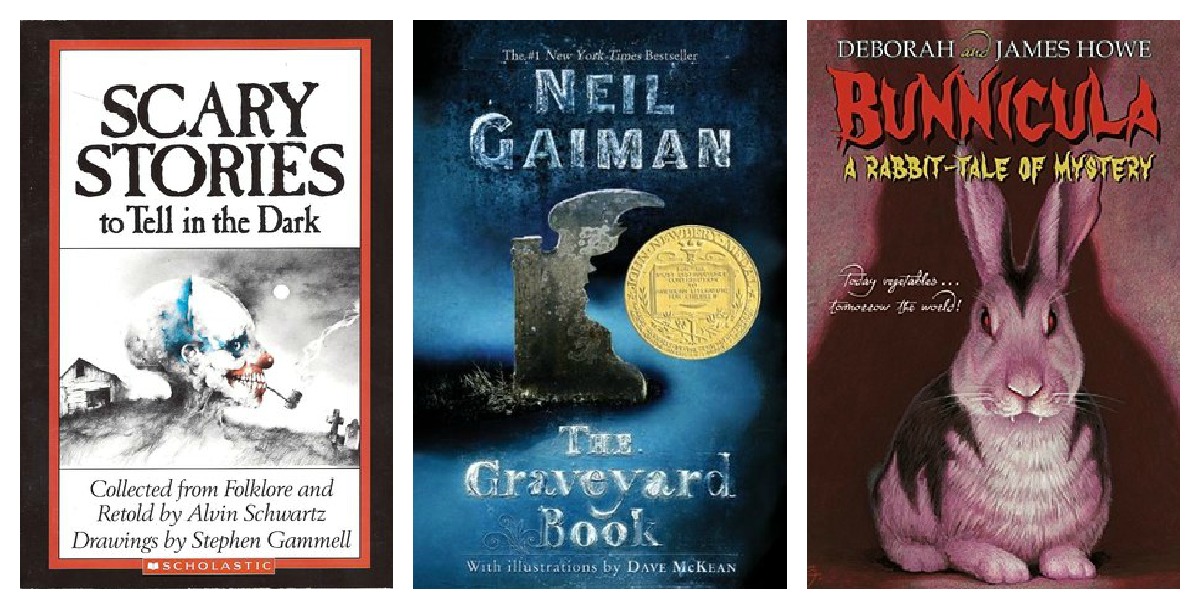
Neil Gaiman's All Hallow's Read
What is All Hallow's Read?
In the words of Neil Gaiman, creator of All Hallow's Read (he's so silly):
Basically, you give someone a scary book for Halloween. Appropriately scary, of course. It can be a kid, a grown up, anyone you know (or don't know. Even strangers like to read. And who doesn't want a free book?)
If you go the All Hallow's Read site, you will find lots of answers to FAQs and also cool extras, such as this book plate that you can print out and affix to the book you are giving away. Or print it onto card stock and make it a bookmark.
On the All Hallow's Read site you can also find book recommendations by Neil Gaiman and links to lists by others.
Here are a few of our family's favorite Halloween reads:
Picture Books:
Middle Grade:
Young Adult:
Ok, so maybe Keturah isn't a Halloween read per se, but since it came out with this new creepy cover it looks like one. And it has Death as a main character. And it's awesome.
What are some scary Halloween books you'd recommend?
In the words of Neil Gaiman, creator of All Hallow's Read (he's so silly):
Basically, you give someone a scary book for Halloween. Appropriately scary, of course. It can be a kid, a grown up, anyone you know (or don't know. Even strangers like to read. And who doesn't want a free book?)
If you go the All Hallow's Read site, you will find lots of answers to FAQs and also cool extras, such as this book plate that you can print out and affix to the book you are giving away. Or print it onto card stock and make it a bookmark.
Here are a few of our family's favorite Halloween reads:
Picture Books:
Middle Grade:
Young Adult:
What are some scary Halloween books you'd recommend?
Saturday, October 6, 2012
Next endeavor
I’m still revising and still getting tired of the old
project.
At one point I thought the thing was okay. It seems the more
time I spend on it; the more doubts have about it. Been working on it coming up
on two years and I’ve felt pretty good about. The endless tweaking and
wrestling over fine points gets tiring.
That equates to less time for the new one. Ah, the next
project. I’m close. I start too many things without wrapping up loose ends. I
want to see the old one to finish. But I’ve got this other story that’s been
stewing and I’m about ready to pull it off the back burner. Maybe I can close
it out this month just in time for NaNoWriMo.
I love the act of writing. I’m coming to appreciate the
value of time spent on developing, story mapping, or whatnot before fingers
take to keyboard. I wrote one book and took it to WIFYR (on it’s second time)
to discover it was vague and wandering. Had most of it worked out by the next
conference, but that was only after figuring out the direction.
Direction good. A story still needs the freedom to wander
and go to unintended places.
I’ve got an idea for the new project, a very rough idea of
where it’s heading. The two main characters are in mind and a few events mapped
out in my head. The genre is a tricky part. My favorite is historical fiction,
a view not many share. There seems to be a disconnect with history and young
readers. As the market speaks, so publishers go for other genres, fantasy, for
example.
Yet historical can be like fantasy, minus the flying dragons
and such. Real people, just like us, but in an other world. Setting becomes its
own character.
Take A Game of Thrones,
a riveting series by George R. R. Martin and a current fascination of my wife
and I on TV. How different is its medieval-like setting from our earlier human
existence? Martin’s main characters jockey for position as their drive for power
drives the story. Lords and Ladies, noble houses, greed, deception, assassins, war:
Game has it all. It could have been set
in feudal Europe of the 1300s. It’s the same kind of stuff Shakespeare wrote.
Minus the dragon eggs, of course. Historical fiction has its place.
That’s the next project, after The End on the old one.
Friday, October 5, 2012
The Most Frequently Challenged Books of 2011
by Scott Rhoades
As part of Banned Books Week 2012, the American Library Association has released its list of the most frequently challenged books of 2011.
According to the ALA website:
"A challenge is defined as a formal, written complaint, filed with a library or school requesting that materials be removed because of content or appropriateness. The number of challenges reflects only incidents reported. We estimate that for every reported challenge, four or five remain unreported. Therefore, we do not claim comprehensiveness in recording challenges."
Here is their list:
As part of Banned Books Week 2012, the American Library Association has released its list of the most frequently challenged books of 2011.
According to the ALA website:
"A challenge is defined as a formal, written complaint, filed with a library or school requesting that materials be removed because of content or appropriateness. The number of challenges reflects only incidents reported. We estimate that for every reported challenge, four or five remain unreported. Therefore, we do not claim comprehensiveness in recording challenges."
Here is their list:
- ttyl; ttfn; l8r, g8r (series), by Lauren Myracle
Reasons: offensive language; religious viewpoint; sexually explicit; unsuited to age group - The Color of Earth (series), by Kim Dong Hwa
Reasons: nudity; sex education; sexually explicit; unsuited to age group - The Hunger Games trilogy, by Suzanne Collins
Reasons: anti-ethnic; anti-family; insensitivity; offensive language; occult/satanic; violence - My Mom's Having A Baby! A Kid's Month-by-Month Guide to Pregnancy, by Dori Hillestad Butler
Reasons: nudity; sex education; sexually explicit; unsuited to age group - The Absolutely True Diary of a Part-Time Indian, by Sherman Alexie
Reasons: offensive language; racism; religious viewpoint; sexually explicit; unsuited to age group - Alice (series), by Phyllis Reynolds Naylor
Reasons: nudity; offensive language; religious viewpoint - Brave New World, by Aldous Huxley
Reasons: insensitivity; nudity; racism; religious viewpoint; sexually explicit - What My Mother Doesn't Know, by Sonya Sones
Reasons: nudity; offensive language; sexually explicit - Gossip Girl (series), by Cecily Von Ziegesar
Reasons: drugs; offensive language; sexually explicit - To Kill a Mockingbird, by Harper Lee
Reasons: offensive language; racism
Thursday, October 4, 2012
Banned Books Week, continued
Following Scott's excellent post on Banned Books Week, I wanted to add my personal experience regarding this topic.
I was born in Argentina at the peak of the last military dictatorship, in 1977. The society in which I was born and raised was oppressed for years until the people united against tyranny and said "Nunca Mas," Never Again. When I was young, there were a lot of things that weren't available to me and the rest of the population. Some of them were books, music, and theater. Whatever made it to the public was dubbed in Spanish with all the consequences this brings. The message was diluted to what a small group of people thought it was okay for society. In fact, it wasn't until I was in my twenties that I read Little Women in English for the first time and discovered that several paragraphs and whole chapters had been deleted from the translated version I had memorized as a child. I felt like I had been hit in the stomach by a futbol going a hundred miles an hour (and I have in real life. I know that feeling very well)
Among other things, I had never even heard of The Hobbit or of the Lord of Rings Trilogy. When I arrived at BYU, one of the first things I did was go to the library. I was overwhelmed by the amount of books that the walls and countless shelves of not one floor, but five! I could have stayed there forever and never go to class. In fact, if I never stepped in a classroom but was allowed to spend as much time as I wanted in that library, I would have been satisfied.
Fortunately, I did go to class; one of the first ones was an English honors in which we discussed The Lord of the Rings. I remember the very first quizz. I studied for hours, unused to the difficult language of the book (English is my second language after all, but Tolkien's wasn't the English I had studied for years).
I was dismayed when I read the questions. I had no idea who Bilbo was, and there were five questions on this character. When I complained to the professor, he said he had included questions from The Hobbit, and since it was popular culture we all should know it.
I still disagree with his logic, although it makes sense in a way. Eventually I did very well in that class, and I think the professor had a reality check: not all students came from the same background and culture, and as a consequence defined popular culture a little different from him.
Where I'm going with this is, no small group of people has the right to say what I am allowed to consider writing/reading/seeing/saying. During the military dictatorship countless artists were exiled from Argentina because their work was deemed revolutionary, anti-patriotic.
When I was in high school I had the blessing of being friends with a group of girls who, like me, loved reading and discussing the ideas we read. We borrowed and lent books to each other, and we talked. There were many books I read that I didn't like. But I could read them, or put them away if I didn't want to continue giving my time to something I didn't enjoy. Yesterday, I was reading a Stephen King's book in English for the first time, and I reached a passage that really disturbed me because of the violence. I put it away. Do I think no one should ever read that book? No. Everyone has the right to read whatever they please. My son is almost twelve, and he's a read-a-holic like his mother. However, there are some books I don't want him to read yet. There is plenty of time for some things. But when he's old enough, they'll be available for him.
Sometimes when we read these now so popular dystopian books, we as readers are horrified by some aspects of those fictional societies. I'm horrified because I lived in one, and the effects of the lack of freedom TO THINK are devastating. My country still hasn't recovered.
Read books. Banned or not. Think for yourself. Give others the same right.
I was born in Argentina at the peak of the last military dictatorship, in 1977. The society in which I was born and raised was oppressed for years until the people united against tyranny and said "Nunca Mas," Never Again. When I was young, there were a lot of things that weren't available to me and the rest of the population. Some of them were books, music, and theater. Whatever made it to the public was dubbed in Spanish with all the consequences this brings. The message was diluted to what a small group of people thought it was okay for society. In fact, it wasn't until I was in my twenties that I read Little Women in English for the first time and discovered that several paragraphs and whole chapters had been deleted from the translated version I had memorized as a child. I felt like I had been hit in the stomach by a futbol going a hundred miles an hour (and I have in real life. I know that feeling very well)
Among other things, I had never even heard of The Hobbit or of the Lord of Rings Trilogy. When I arrived at BYU, one of the first things I did was go to the library. I was overwhelmed by the amount of books that the walls and countless shelves of not one floor, but five! I could have stayed there forever and never go to class. In fact, if I never stepped in a classroom but was allowed to spend as much time as I wanted in that library, I would have been satisfied.
Fortunately, I did go to class; one of the first ones was an English honors in which we discussed The Lord of the Rings. I remember the very first quizz. I studied for hours, unused to the difficult language of the book (English is my second language after all, but Tolkien's wasn't the English I had studied for years).
I was dismayed when I read the questions. I had no idea who Bilbo was, and there were five questions on this character. When I complained to the professor, he said he had included questions from The Hobbit, and since it was popular culture we all should know it.
I still disagree with his logic, although it makes sense in a way. Eventually I did very well in that class, and I think the professor had a reality check: not all students came from the same background and culture, and as a consequence defined popular culture a little different from him.
Where I'm going with this is, no small group of people has the right to say what I am allowed to consider writing/reading/seeing/saying. During the military dictatorship countless artists were exiled from Argentina because their work was deemed revolutionary, anti-patriotic.
When I was in high school I had the blessing of being friends with a group of girls who, like me, loved reading and discussing the ideas we read. We borrowed and lent books to each other, and we talked. There were many books I read that I didn't like. But I could read them, or put them away if I didn't want to continue giving my time to something I didn't enjoy. Yesterday, I was reading a Stephen King's book in English for the first time, and I reached a passage that really disturbed me because of the violence. I put it away. Do I think no one should ever read that book? No. Everyone has the right to read whatever they please. My son is almost twelve, and he's a read-a-holic like his mother. However, there are some books I don't want him to read yet. There is plenty of time for some things. But when he's old enough, they'll be available for him.
Sometimes when we read these now so popular dystopian books, we as readers are horrified by some aspects of those fictional societies. I'm horrified because I lived in one, and the effects of the lack of freedom TO THINK are devastating. My country still hasn't recovered.
Read books. Banned or not. Think for yourself. Give others the same right.
Wednesday, October 3, 2012
A Sense of Mission
by Deren Hansen
Richard N. Bolles is justifiably well-known for, What Color is Your Parachute?, his perennial guide for job seekers. It’s a shame, though, that he isn’t equally well-known for another book, The Three Boxes of Life. Where Parachute is about the how of finding a job, Three Boxes is about the why.
One of the most important lessons every skilled craftsperson must learn is just because you can doesn’t mean you should. The greatest works of art are exercises in restraint not excess. With the possible exception of tabloid celebrities, the greatest careers and lives exemplify the power of purpose and restraint.
Among the many mind-opening ways of living life by design, not accident, in The Three Boxes of Life, Bolles explains how a sense of mission can inform the thousand and one choices you’ll make in the course of a career and a life:
The fact that so many businesses responded to the fad of creating a mission statement with platitudes and generalities doesn’t diminish the value of a genuine sense of mission.
Don’t be put off by the lofty overtones of the word, “mission.” While there certainly may be occasions when much is at stake, our mission is no more or less than being able to answer questions like, “Why are you doing this? What do you hope to accomplish?”
Artisan publishing isn’t a shortcut, or a way to get back at a publishing industry that failed to recognize your genius. Like the work of all skilled craftspeople, artisan publishing is a patient, laborious path. It’s not enough to have the skill, the aptitude, or even the inclination to publish your own material. You need to know why, both for your particular project and for you as an individual, the way of the artisan is worth all the time and trouble it will cost you.
A journey of 1000 miles may well begin with a single step, but your chances of completing the roughly 2,000,000 steps that comprise the journey are poor if you don’t know why you’re doing it. There are many poor reasons—one of the worst being because everyone else is doing it—and only a few good ones. The difference is that poor reasons wear away when the going gets tough but good ones will see you through to the end.
No true craftsperson undertakes a work lightly — not because their work has mystical significance but because the hallmark of skill is to act deliberately. In order to act deliberately you need to know why you’re acting: you need to have a sense of mission. Otherwise, you’ll provide yet another confirmation of the old aphorism that if you’re aiming at nothing you’ll hit it.
Deren Hansen is the author of the Dunlith Hill Writers Guides. Learn more at dunlithhill.com.
Richard N. Bolles is justifiably well-known for, What Color is Your Parachute?, his perennial guide for job seekers. It’s a shame, though, that he isn’t equally well-known for another book, The Three Boxes of Life. Where Parachute is about the how of finding a job, Three Boxes is about the why.
One of the most important lessons every skilled craftsperson must learn is just because you can doesn’t mean you should. The greatest works of art are exercises in restraint not excess. With the possible exception of tabloid celebrities, the greatest careers and lives exemplify the power of purpose and restraint.
Among the many mind-opening ways of living life by design, not accident, in The Three Boxes of Life, Bolles explains how a sense of mission can inform the thousand and one choices you’ll make in the course of a career and a life:
“There yet remains however, one still deeper answer to the issue of MEANING OR MISSION. That is to find, beyond meaning, some ultimate goal or mission for your life, that drives you on with the kind of sacrificial, burning passion. It is the kind of mission that drove Pasteur, Schweitzer, Einstein and many lesser names. It is the kind of drive that — in any or every profession — distinguishes some men and women from the rest of ‘the common herd.’”
The fact that so many businesses responded to the fad of creating a mission statement with platitudes and generalities doesn’t diminish the value of a genuine sense of mission.
Don’t be put off by the lofty overtones of the word, “mission.” While there certainly may be occasions when much is at stake, our mission is no more or less than being able to answer questions like, “Why are you doing this? What do you hope to accomplish?”
Artisan publishing isn’t a shortcut, or a way to get back at a publishing industry that failed to recognize your genius. Like the work of all skilled craftspeople, artisan publishing is a patient, laborious path. It’s not enough to have the skill, the aptitude, or even the inclination to publish your own material. You need to know why, both for your particular project and for you as an individual, the way of the artisan is worth all the time and trouble it will cost you.
A journey of 1000 miles may well begin with a single step, but your chances of completing the roughly 2,000,000 steps that comprise the journey are poor if you don’t know why you’re doing it. There are many poor reasons—one of the worst being because everyone else is doing it—and only a few good ones. The difference is that poor reasons wear away when the going gets tough but good ones will see you through to the end.
No true craftsperson undertakes a work lightly — not because their work has mystical significance but because the hallmark of skill is to act deliberately. In order to act deliberately you need to know why you’re acting: you need to have a sense of mission. Otherwise, you’ll provide yet another confirmation of the old aphorism that if you’re aiming at nothing you’ll hit it.
Deren Hansen is the author of the Dunlith Hill Writers Guides. Learn more at dunlithhill.com.
Sunday, September 30, 2012
Banned Books Week
by Scott Rhoades
This year, banned books week starts today, running from September 30 to October 6.
I admit, I have a problem with the concept of banning books. On the other hand, I recognize that it is not as simple as saying "Don't ban books." As with any art form, there are a number of possible personal reactions to a controversial book. For example, a book that depicts abuse of a child might cause a dangerous emotional reaction in one child who has been abused or has witnessed abuse, while another might find solace and comfort in seeing how a character handles the trauma within the safe environment of a book. As parents, we know our children, and we should have the right to opt our child out of reading certain kinds of books. The problem is, as I said, the book you challenge for your child might be one I want my child to read.
So, what upsets me is when one parent or set of parents attempts to restrict a book from everybody else, whether it's in a school, a library, a bookstore, or anywhere else. I have no desire to withhold controversial topics from my kids, and a book is, usually, a safe way to introduce kids to discussions on racism, sexuality, political theories, and other subjects that often result in challenges. At the same time, if I truly believed a book could harm my child or cause issues based on my child's particular sensitivities, I'd like to be able to opt my child out of that assignment. However, I will never attempt to opt your child out, or to restrict the book's availability to others.
This, unfortunately, is what book challenges are about, restricting books from others because one group of people dislikes it, is offended by it, or doesn't agree with the book's message. That's why I fully support the activities of Banned Book Week.
This year, one of my reading goals was to read ten books that are often found on the ALA's list of most challenged books. I achieved that goal back in June, but continue to go to the ALA lists now and then when trying to find my next book. Here are the frequently challenged books I've read so far, in order of completion:
1. The Two Towers, JRR Tolkien
2. Lolita, Vladimir Nabokov
3. The Grapes of Wrath, John Steinbeck
4. Invisible Man, Ralph Ellison
5. The Giver, Lois Lowry
6. To Kill A Mockingbird, Harper Lee
7. The Return of the King, JRR Tolkien
8. The Hunger Games, Suzanne Collins
9. The Golden Compass, Philip Pullman
10. Fahrenheit 451, Ray Bradbury
11. Madame Bovary, Gustave Flaubert (This one actually got its author arrested)
12. Rabbit, Run, John Updike
13. 1984, George Orwell
Books on this list have been challenged for containing magic, sexual content, racial subject matter, violence, and religious or political ideology.
I have little doubt than anybody reading this list won't look at some of the titles with disbelief, finding it hard to understand how it could be on the list at all. It also wouldn't surprise me if several readers look at some of the titles and support restricting availability of the book in schools, questioning age appropriateness or whatever. And a few of you might not even want a couple of these books to be available in your child's school library whether your child is assigned the book or not, or even in the public library.
Every one of these books is partially responsible for making this maybe my most amazing reading year ever. Many of them are books I had never read before, and most of them blew me away with their literary artistry and the messages they deliver. To be sure, I wouldn't assign Rabbit, Run or Lolita to a junior high school English class, but I would have no issue whatsoever assigning either one to an AP English class in a high school. Both are amazing books. If somebody tried to make either one unavailable from my local library, you'd better believe I'd raise a stink of my own.
When I see those lists of banned books, especially the ones with details about the nature of the challenges, it shocks me how often people challenge the availability of the book to anyone at all, not just to themselves or their own children. Some of the challenges are silly. Some are well-meaning but misinformed. Others have validity but should remain matters of personal choice. And few people will agree on which challenges fit in which bucket.
By all means, exercise your rights as parents of your children. If you challenge a reading assignment, I hope it will be an informed decision based on more than an emotional response or over-protectiveness, and will be done with careful thought and with consideration for the rights and beliefs of others. I hope it will be specific to your child. I also hope it will take into consideration the teacher's skills at presenting difficult subject matter in a sensitive way. An excellent teacher can present a tough subject in a way that goes far beyond the quality of the book.
My youngest child is 14. There's not one book on my list above that I would not want him to read. (Actually, I'd be thrilled to see him reading anything at this point.) Some of the books might merit extra discussion based on his own sensitivities, and I might question the age-appropriateness of one or two of the books, based on his own level of emotional maturity. But at his age, maturity varies greatly from child to child, and each child's reaction to various subjects can also be quite different. A child who is well equipped to discuss subjects like race and sexuality might have difficulty with violence, for example. My child's reactions will not be the same as your child's for all books.
Controlling access to controversial ideas is a questionable activity, in my opinion, but, as I said, I respect the rights of parents to have a say in what their children read, even if I disagree with them. However, I also believe that attempting to control access to ideas for people who are outside your own realm of responsibility is disrespectful of the rights and beliefs of others, and, frankly, is just plain bad manners.
Remember, if one group is allowed to withhold ideas from another, then sooner or later, it will be a group you support who is told you are not allowed access to an idea that is important to you. That's why we should all be concerned whenever a book is challenged, whether we agree with the challengers or not.
Ultimately, Banned Book Week is about celebrating the freedom to read what we choose, without having our choices restricted by others, whether they are political despots or well-meaning concerned parents.
This year, banned books week starts today, running from September 30 to October 6.
I admit, I have a problem with the concept of banning books. On the other hand, I recognize that it is not as simple as saying "Don't ban books." As with any art form, there are a number of possible personal reactions to a controversial book. For example, a book that depicts abuse of a child might cause a dangerous emotional reaction in one child who has been abused or has witnessed abuse, while another might find solace and comfort in seeing how a character handles the trauma within the safe environment of a book. As parents, we know our children, and we should have the right to opt our child out of reading certain kinds of books. The problem is, as I said, the book you challenge for your child might be one I want my child to read.
So, what upsets me is when one parent or set of parents attempts to restrict a book from everybody else, whether it's in a school, a library, a bookstore, or anywhere else. I have no desire to withhold controversial topics from my kids, and a book is, usually, a safe way to introduce kids to discussions on racism, sexuality, political theories, and other subjects that often result in challenges. At the same time, if I truly believed a book could harm my child or cause issues based on my child's particular sensitivities, I'd like to be able to opt my child out of that assignment. However, I will never attempt to opt your child out, or to restrict the book's availability to others.
This, unfortunately, is what book challenges are about, restricting books from others because one group of people dislikes it, is offended by it, or doesn't agree with the book's message. That's why I fully support the activities of Banned Book Week.
This year, one of my reading goals was to read ten books that are often found on the ALA's list of most challenged books. I achieved that goal back in June, but continue to go to the ALA lists now and then when trying to find my next book. Here are the frequently challenged books I've read so far, in order of completion:
1. The Two Towers, JRR Tolkien
2. Lolita, Vladimir Nabokov
3. The Grapes of Wrath, John Steinbeck
4. Invisible Man, Ralph Ellison
5. The Giver, Lois Lowry
6. To Kill A Mockingbird, Harper Lee
7. The Return of the King, JRR Tolkien
8. The Hunger Games, Suzanne Collins
9. The Golden Compass, Philip Pullman
10. Fahrenheit 451, Ray Bradbury
11. Madame Bovary, Gustave Flaubert (This one actually got its author arrested)
12. Rabbit, Run, John Updike
13. 1984, George Orwell
Books on this list have been challenged for containing magic, sexual content, racial subject matter, violence, and religious or political ideology.
I have little doubt than anybody reading this list won't look at some of the titles with disbelief, finding it hard to understand how it could be on the list at all. It also wouldn't surprise me if several readers look at some of the titles and support restricting availability of the book in schools, questioning age appropriateness or whatever. And a few of you might not even want a couple of these books to be available in your child's school library whether your child is assigned the book or not, or even in the public library.
Every one of these books is partially responsible for making this maybe my most amazing reading year ever. Many of them are books I had never read before, and most of them blew me away with their literary artistry and the messages they deliver. To be sure, I wouldn't assign Rabbit, Run or Lolita to a junior high school English class, but I would have no issue whatsoever assigning either one to an AP English class in a high school. Both are amazing books. If somebody tried to make either one unavailable from my local library, you'd better believe I'd raise a stink of my own.
When I see those lists of banned books, especially the ones with details about the nature of the challenges, it shocks me how often people challenge the availability of the book to anyone at all, not just to themselves or their own children. Some of the challenges are silly. Some are well-meaning but misinformed. Others have validity but should remain matters of personal choice. And few people will agree on which challenges fit in which bucket.
By all means, exercise your rights as parents of your children. If you challenge a reading assignment, I hope it will be an informed decision based on more than an emotional response or over-protectiveness, and will be done with careful thought and with consideration for the rights and beliefs of others. I hope it will be specific to your child. I also hope it will take into consideration the teacher's skills at presenting difficult subject matter in a sensitive way. An excellent teacher can present a tough subject in a way that goes far beyond the quality of the book.
My youngest child is 14. There's not one book on my list above that I would not want him to read. (Actually, I'd be thrilled to see him reading anything at this point.) Some of the books might merit extra discussion based on his own sensitivities, and I might question the age-appropriateness of one or two of the books, based on his own level of emotional maturity. But at his age, maturity varies greatly from child to child, and each child's reaction to various subjects can also be quite different. A child who is well equipped to discuss subjects like race and sexuality might have difficulty with violence, for example. My child's reactions will not be the same as your child's for all books.
Controlling access to controversial ideas is a questionable activity, in my opinion, but, as I said, I respect the rights of parents to have a say in what their children read, even if I disagree with them. However, I also believe that attempting to control access to ideas for people who are outside your own realm of responsibility is disrespectful of the rights and beliefs of others, and, frankly, is just plain bad manners.
Remember, if one group is allowed to withhold ideas from another, then sooner or later, it will be a group you support who is told you are not allowed access to an idea that is important to you. That's why we should all be concerned whenever a book is challenged, whether we agree with the challengers or not.
Ultimately, Banned Book Week is about celebrating the freedom to read what we choose, without having our choices restricted by others, whether they are political despots or well-meaning concerned parents.
Saturday, September 29, 2012
Revision
Writing the story is the fun part. The revision phase is not
as enjoyable. Unfortunately, it is a step that must be taken.
After months and months, I’m ready to move on to a next
project. Yet the old one is still there, like a bad cold that won’t go away.
I’ve put in my time. I had fun developing it. Can’t I just be done with it?
Not if I want it published.
My critique group looked at it and had wonderful suggestions.
Some were the obvious, slap-your-forehead, yeah-I-knew-that type of ideas. At
other times, I wondered why those guys weren’t getting it. It’s so obvious to
me. Evidently, it isn’t apparent to everyone. That kind of reality check is why
I keep them around.
The fixes should be easy, a piece of cake. A week, maybe two
then I can send it off to someone. At that point it will be out of my hands with
nothing more I can do about it. I’ll have time to work on something else.
But two weeks then three pass and it’s still not done. Revision
takes time.
Moving a work to publication is new to me. I think I know
how to proceed. Pretty much, anyone who would consider putting this on the
market wants it to be good, wants it clean. I think I’ve got story but that’s
up to others to decide. The cleansing part is all mine and a necessity to move
forward.
The grammar and spelling are easy to fix, the missed or
extra word as well. You’d think spell check would have caught it but my
critique group found more.
It’s the other that takes so much time. Tightening the
language takes time.
Comments like “too much exposition” require a decision. Is
it really too much? Does it really slow the story? If so, how much do I keep,
what do I pitch out? It’s these kinds of things that take so much time. And why
spend all this time now? The agent or editor will just have me do it again, to
their liking.
Okay, that’s off my chest. I feel better now. Need to get
back to the revision.
Subscribe to:
Posts (Atom)