Tuesday, April 9, 2013

30 Days: "The Waiter"


The Waiter
By Lana Krumwiede

I’ll serve you soup but not spaghetti.
I’ll bring you ice cream when you’re ready.
I’ll dish up pudding smooth and sweet.
But I’ll never cut your meat.

When we’re in a formal setting,
I’ll thank you not to be forgetting
To put me in my place beside
That slender, tall, sharp-looking guy.


Lana Krumwiede is the author of Freakling, a middle-grade science fiction novel which is Book One in The Psi Chronicles (Candlewick, 2012). Freakling is a Whitney Award finalist and a Crystal Kite finalist. Book Two, Archon, will be released in October of 2013. Lana has also published over 50 poems and stories in magazines such as The Friend, Cricket, Highlights, and High Five. In fact, one of her stories is in this month’s issue of The Friend.  A former resident of Utah and Idaho, Lana now lives in Richmond, Virginia. You can learn more about her books at www.lanakrumwiede.com .

Monday, April 8, 2013

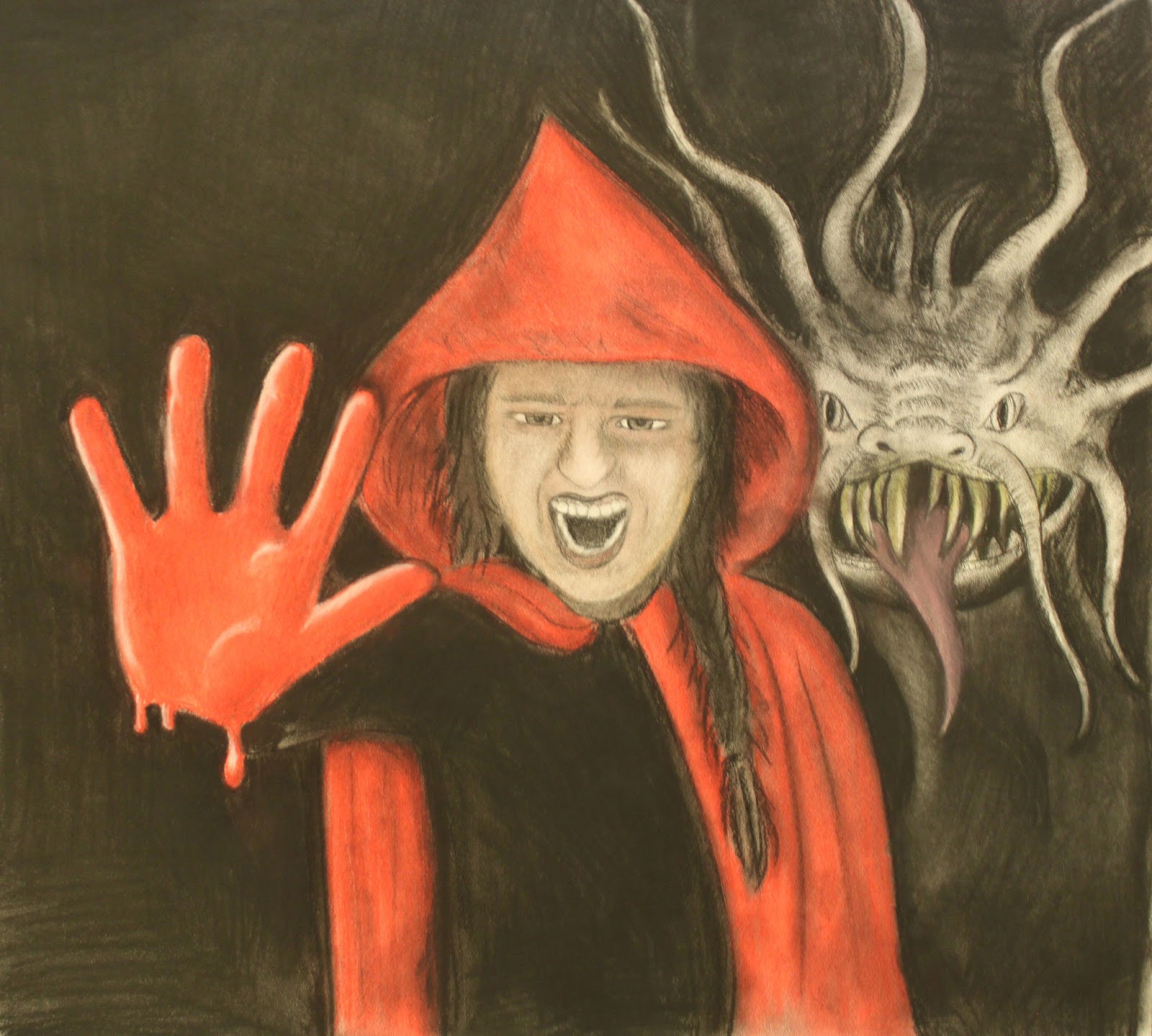
30 Days: Fan Illustration for Sisters Grimm

This is an illustration that I did for fun - it is for the Sisters Grimm YA series The Fairy Tale Detectives, book 3 The Problem Child. The series is written by Michael Buckley. This is Little Red Riding Hood and the Jabberwocky - members of a terrorist group called the Scarlet Hand - if you are confused, read the books - they are great! :D

Sunday, April 7, 2013

30 Days: "Hawkeye"


"Hawkeye" by Melissa Stockham 

Chapter 1
Graham pushed the chain link gate open as far as it would go with the heavy chain holding it to the fence. He slipped his wiry form through the opening and bent to pick up his backpack that he’d thrown over the fence.

He slid it back on and adjusted its weight before continuing his shortcut home. He surveyed the half-burnt ruins of the old mental hospital and silently agreed with his friends. The place looked creepy as hell.

Jacob told him he was nuts for cutting across the property, but it shaved a good twenty minutes off his walk home. Until he had a good reason not to, he would use his shortcut.

He kicked a rock down the concrete pathway until it skittered off into the weeds. He watched it go and focused on the walk through the courtyard to the other side of the property.

It was the scariest part to travel through. The first time he’d taken his shortcut he had done it at a sprint, which had resulted in a skinned knee and torn pants. Not to mention a bruised ego.

The flame darkened windows were still sinister, anything could be hiding behind them. The fact that they were covered with bars didn’t help calm his imagination any less. The thought of all those people trying to get out while the building burned around them, stopped by the bars that were supposed to keep them safe…

“Slow down,” he muttered when he realized he’d started running, “stop being a baby.” He shoved his hands in his pockets and made his way to the giant statue in the middle of the courtyard.

General ‘Hawkeye’ Smith's bronze form was covered in pigeon poo. Graham glanced up to look at the General stare off into nothingness and tripped. He caught himself and looked down to see what the offender was.

His shoelace had come untied.

He placed his foot up on the base of the statue and leaned over to tie his shoe. As he was finishing his knot he heard something above him. He glanced up and saw a pigeon, flapping its wings and laying a dump on the General’s shoulder.

Then he saw that the General had moved.

He backed away from the statue slowly. No doubt about it, the General had gone from gazing off into nothingness to staring straight at him. He felt a chill down his spine and he shivered. He wondered if the pigeon poo had finally weighed too much for the old statue and its head had tilted. That had to be the answer. Then it blinked.
Graham didn’t wait to see what else it could do. He ran. He heard something else move behind him, creaking and groaning like a car being mashed. He wasn’t about to turn and see if the general had come off his perch. He ran faster, hoping his gangly legs wouldn’t trip over themselves as they often did when he was least expecting.

His heart was pounding in his ears as he reached the other side of the grounds. Usually he’d repeat his steps of throwing his backpack over the fence and slipping through the gate. Today, he cleared the eight foot fence in about three seconds, landing with a crash into an ugly heap complete with scraped hands.

He turned around. He gasped for breath and searched the area for whatever could have been chasing him. The grounds were quiet. Nothing looked remotely out of the ordinary. A quiet breeze moved the weeds back and forth that had sprung up against the fence.

His hands stung as he stood up and wiped them on his pants. He inspected the damage and picked a few pebbled out of his skin. At least his pants weren’t torn. His mother would be happy about that. She a warped sense of humor, 'torn skin healed easier than torn pants'.

He inhaled deeply and turned his back on the ruins, not hearing the giggles that were carried away by the wind.


Most of his family was home when he arrived. His older brother’s piece of crap car was in the driveway, and his legs sticking out from under it. He heard Alex tinkering with something, and gave his legs a brotherly nudge as he walked into the house.

“Sure hope your grades are up!” Alex hollered from under the car. Graham was grateful for the heads up. Mom must be on an ‘I need to be a better mother, so I’m going to scrutinize your life for the next few days and see what I can do to fix it’ kick. She did it about once a month. Graham found it annoying, as much as he knew that it was her way of showing love. Parents were so weird.

He walked in the house and plopped his backpack down on the couch. “Mom! I’m home.”

“M’kay! Do your homework.” Mom called from the kitchen. So predictable.

Ruby was on the couch, reading, as usual. His younger sister always had her nose in a book. She glanced up at him briefly to acknowledge his presence, and added a glare because he had almost hit her with his backpack.

“Sorry.” He grinned. Sisters were so fun to tease.

She shook her head and proceeded to ignore him.

He wandered into the kitchen where mom was starting dinner. Something from scratch and not store bought. Sweet.

“Hi sweetheart,” she leaned over and kissed his hair like a little boy. He sighed, wishing he’d reach a growth spurt. Ruby was taller than he was, which sucked. Alex was much taller. The gene had skipped him somehow.

He watched his mom putter around for a moment. “So, I cut through the hospital tonight.”

Inwardly, he loved the disapproving look Mom gave him. Outwardly, he looked repentant. “Creepy stuff there. I heard something moving around.” A giant bronze statue with bird poop…

“Probably some homeless looking for a place to live. Don’t go through there anymore.” She gave him the ‘I mean it’ look.

“M’kay, sorry.” He felt better, hearing Mom’s reasonable explanation. “Did they ever figure out how it burned down?” He glanced down at his scraped hands and decided it was time for a wash. He headed to the kitchen sink and turned on the water.

“No. I don’t think it was a bad thing either. That place was old. They’d remodeled it so many times there was hardly enough to call original building. If it wasn’t on the historical record, I’m sure the city would raze it and start over. What did you do to your hands?”

“Tripped.”

She shook her head, “You are not going to be a pallbearer at my funeral.”

“Ouch, that’s cold, Mom.” It was a running joke in his family about his inability to stay on his own two feet.

He finished washing his hands and flicked water on Mom, who flicked some back. They grinned at each other and he slipped out of the kitchen before she could ask about his grades.

He went to retrieve his pack. He picked it up and turned to walk away when Ruby spoke. “You better stop taking that shortcut. There’s no homeless people there. It’s haunted.”

The chill he’d felt earlier tickled his spine. “Shut up, it is not.”

She turned a page on her book, “Fine, don’t believe me. Even though, I did write my state history report on it last year. It’s definitely haunted.”

He cringed and took the bait. “Why do you say that?”

“It started out as a military barracks. General ‘Hawkeye’ Smith was in charge of it then. Lots of soldiers died there in the Civil War during a siege. Then, after the war, they expanded it with more buildings and turned it into a military hospital. Then the government turned it over to the state and they filled it with mentally ill. They weren’t very advanced back then. They did crappy stuff to the patients, thinking they were helping. Combine that with low funding and low staff to patient ratio and it was a real mess.”

“Ruby, no twelve year old I know uses the word ‘ratio’ in a sentence,” Graham pointed out.

“Just the nerds do,” She smiled proudly at him. “Anyway, lots of people died there. Soldiers, doctors, patients, nurses, babies. There is even a cemetery on the grounds. I talked with a nurse who worked there before the fire; she told me tons of ghost stories. That place is filled with them.”

“Overachiever. You are the only nerd I know that would actually visit the place you are doing research on.”

She stuck her tongue out at him. “Just telling you. The place is haunted.”

He couldn’t disagree at the moment. The General’s blank bronze eyes were still fresh in his memory.

He picked up his backpack and started to head to the basement when his Dad came home. He walked in the door, sorting the mail as was his habit.

“How’s everyone?” He asked, giving Mom a kiss.

“Fine, except Graham is taking a shortcut through Hawkeye to get home.” Mom looked at Graham.

He rolled his eyes, of course she’d have to pull Dad into it. Two parents ganging up on you were better than one.

“Knock it off.” Dad gave him a stern look, “That building could fall at any moment, and there are probably drug dealers and kidnappers running around there.”

The drug dealers and kidnappers were a new twist. Would they hang around with all the ghosts there? Somehow, Graham doubted it.

He assisted his sister with setting the table as Alex came in from working on his car. Mom and Dad insisted on dinner together, something about the moral fiber of society depending on it.

Afterwards, he did his homework and watched Alex fiddle with some piece of machinery at the kitchen table.

“Dad’s gonna kill you if you scratch the table,” He pointed out to his older brother.

“Dad’s always gonna kill me for something.” Alex muttered. He tinkered with the part and swore as oil spilled out of it.

“Now Mom is going to kill you too.” Graham added.

“Not as dead as you’ll be if you go in Hawkeye again.” Alex said, wiping up the mess before it dripped off the table.

“I don’t see what the big deal is.” Graham turned back to his homework. “It’s not like I went inside or anything. I just cut through the grounds.”

Alex pointed a screwdriver at him, “That’s what Lyle Johnson was doing, and you know what happened to him.”

Graham inwardly growled as another of his siblings dangled bait in front of him that he couldn’t resist. 
“What happened to him?”

“No one knows. He always used Hawkeye as a shortcut. Bragged about it too, that he had some kind of hideout set up in there. Then one day he never came home. They searched the place from top to bottom, found a stash of his stuff sprinkled with some cocaine, and that was that. Cops were sure that some druggie had whacked him.”

“You and Dad say drug dealers, and Ruby says ghosts.” Graham closed his Algebra book.

“Maybe both.”

“Drug dealing ghosts. Yeah, you hear a lot about them in the news. Cops can’t keep them locked up because they keep walking through walls.”

Alex snorted. “Seriously. If you were a drug dealer, where would be the best place to hide stuff? Someplace haunted, that’s what I’d do.”

Graham digested this, and the fact that his brother had actually thought where to hide illegal paraphernalia, and then hit the shower before going to bed.

Chapter 2
For the next week, Graham took the long way home. He dutifully walked around the perimeter of the hospital, glancing at its looming form with the darkened windows. He wondered briefly if the General was still on his perch covered in pigeon poo.

If he was a giant moving statue, he’d be splatting those pests like flies.

He had fully intended to keep his promise to stay out of Hawkeye, until it rained that Friday.
It wasn’t just a little drizzle. It was a full out brawl in the skies with lightning, thunder and a downpour. He was pretty sure he couldn’t get any wetter than if he’d stepped into the shower with all his clothes on.

The gate to Hawkeye looked inviting. He was pretty sure all the drug dealers and baddies wouldn’t come out on a day like today. He tossed his backpack over and slid through the gate. He picked it up and ran towards the main building, finding a dry patch under the front door of the old hospital. He dropped his pack on the ground and hugged himself, shivering. He hated being a skinny kid with no body fat to keep him warm.

The storm didn’t let off. He sank to the ground, leaning against the door of the hospital and hugging his knees. He buried his head for a moment while the air crackled around him. Mom was so going to kill him for not taking a jacket, especially since it was the last thing she’d yelled to him before he’d walked out the door. He started brainstorming a way to make nice, or maybe get pity.

He felt the door behind him vibrate right before it flew open. He fell backwards into the foyer of the hospital and smacked his head hard on the floor.

Normally, he didn’t swear. Ever. He didn’t think it made you look cool or sound grown-up, and there were better, more creative words to use. But at that moment he let go with a loud string of curse words.  

He saw stars for a moment, as he rubbed his head.

He then heard someone giggling.

It was enough to set his hair standing on end and get his feet in motion. He raced outside into the rain and ran as fast as he could.

His vision was impaired by the rain, and he slid on the wet pavement a few times. He made it to the courtyard and was passing General Hawkeye’s statue when it came to life.

This time, it didn’t just tilt its head and blink. It came off its pedestal and plucked up Graham like a baby kitten and held him between two fingers.

He screamed and thrashed as the thunder roared. He was pretty sure he might have lost control of other bodily functions as he cried like a little girl.

The large statue carried him back to the hospital doors and dropped him unceremoniously on the ground into the foyer. It left the building and slammed the door shut behind it.

Graham scrambled back to his feet and wiped his nose. He ran for the door and tried to open it. It wouldn’t budge an inch.

“I’m sorry, I’m so sorry.” A voice came from behind him. He slammed his body against the door to get away from this new threat.

A girl was walking towards him. She was pale and thin, her hair messy and tangled. Her clothes were dirty and covered with soot, along with her smudged face.

She gave him a smile, that didn’t do much to relax him, and slapped a hand on the door. The bang echoed through the hospital. “General! That was very mean! You let him go right now!”

Graham heard a rumbling and scraping of metal on the other side of the door. It was then flung open and he saw the bronze statue retreating into the rain.

The girl stared at the floor. She was his height, which wasn’t much of an accomplishment. “He knows I get lonely, and you make me laugh. He was trying to help.”

Graham opened and shut his mouth like a fish for a moment. “Are you a…ghost?”

She nodded, looking at him from under her long dirty stringy hair.

“And that…thing?”

“That’s General Hawkeye. He didn’t want to leave his men or his family, so here he is, wandering around protecting the place.”

“So this place is haunted.”

She nodded, “Most definitely haunted.”

He shivered. “How long have you been…”

“Dead?” her face brightened a little, “About six months, during the fire. I was here visiting my dad with my mom when the fire broke out. We were stuck inside.”

“Sorry.”

She shrugged, “It’s no big deal. I just get kinda lonely, there’s no other kids.”

There was a large crash behind them, and he saw a dirty vase filled with dead flowers smash into the ground.

She rolled her eyes, “No other kids my age. Joey is about 7, and a pain.”

Graham coughed, “Wow.” He felt cold again and shivered. He rubbed his arms up and down to warm them.

“Anyways, the General is really nice, promise, he knows I liked to watch you every day. When you 
didn’t come back, I was sad.”

“You watched me?” Graham raised his brows.

“Yes. Everyday. It made me feel normal for a minute. Like I lived in a normal house again and could watch kids walk home from school like I used to do.”

Graham exhaled, “This is totally blowing my mind.”

“Yeah, it blew mine too.”

“Look, I gotta go, or my mom is going to send out a search party.” He reached down for his backpack that he had left behind.

She nodded, “OK. Will you come back?”

He chewed on his lip for a moment. Her eyes were hopeful, and she wasn’t some scary zombie faced gross out chick with burnt skin, she looked pretty normal. “Ok, but only if the General will stop scaring the crap out of me.”

She smiled. Her teeth were white and stuck out sharply in contrast to her dirty face. “Deal.” There was another large crash as a mirror landed on the ground. She sighed, turning around and shouting, “KNOCK IT OFF, JOEY!”

Graham checked to see that there was no large heavy objects above him before walking out the door.

She raced to the doorway and called out to him in the rain, “What’s your name!”

He turned around in the drizzle and called back, “Graham.”

“I’m Tyanne! Come back soon!”

He nodded, and trotted off in the rain towards home. He passed by the General’s statue. The bronze eyes followed him, much like a protective father staring down his daughter's new boyfriend.

“Be nice!” Graham reminded him.

Saturday, April 6, 2013

30 Days: "Spiders and Snakes"


Eddie Brickell was just like any other fifth grade boy.
No he wasn't.
All the other boys had no problem holding Mr. Slithers, the class pet. They could reach into its cage, pull the snake out, and let it coil himself around their arms or neck or shoulders. Not Eddie.
            Not the girls either. They wouldn’t come near it or they would shriek if a boy held the snake up to them. Except for Amanda. She was the only girl brave enough to hold Mr. Slithers.
            The thing gave Eddie the willies. He didn’t squeal like a girl, though he wanted to.
            So far no one had caught on to him. He played the tough guy part like all the others. He would hang around the cage and pretend to be interested. And with so many boys clamoring to hold Mr. Slithers, no one noticed that Eddie had never touched it. No one questioned his courage.
But the plain fact was that boys are supposed to be manly and snakes don’t bother macho boys. It’s as though he had failed at being a kid. How could a self-respecting guy move on to middle school if he were afraid of snakes?
And that is why he found himself alone, at recess, standing before Mr. Slithers cage. He had snuck back into the room after the teacher had left. Eddie was bound and determined to be brave and overcome his anxiety.
The glass aquarium cage was capped with a framed screen top, which was held tight with nylon straps. Eddie undid the latches and removed the screen. When he did, Mr. Slithers moved out from its hiding place under a rock. The snake slid its body up the side of the glass cage, stared, and pushed out its forked tongue. The hairs stood on the back of Eddies neck and he plopped the screen back in place.
He was repulsed, yet he couldnt take his eyes off the reptile. Its head was black and shiny and a round beady eye stared at him. Red and black and yellow rings went the length of its body, slimming as it reached its tail. Its upper body held to the glass and its head swayed, licking the air with its tongue.
Eddie sucked in his breath and raised the screen. The snake brought itself an inch higher. Eddie slowly reached his arm over the rim and the snake bobbed its head. Eddie pulled his arm back out of the cage.
This is stupid, he thought. Its a harmless snake, no more than a foot long. Every guy in class can do this. Why couldnt he?
Eddie reached his hand over the cage and hovered there. The heat from the warming lamp warmed his arm. He took in a breath and willed himself to grab the thing behind its head. He reached closer to it when a voice said, Scared, arent you?
Eddie turned his head toward the voice. No, Im not scared.
Yes you are, said Amanda. She walked toward the cage. You never pick it up. You never pet it. Ive watched you. Youre afraid of it.
Eddie puffed his chest and put on his tough guy face. Afraid of Mr. Slithers? Ha. Im not afraid of a silly little snake.
Amanda held his gaze for a second then said, Okay, then. Pick him up.
Eddie looked at her and said, No problem. He turned to face the cage and gathered his courage. He sucked in his breath, sighed it out, and reached over the edge. The snake moved its body toward his hand. Eddie willed himself to be brave. He stared into its beady eyes and decided to make a move before he lost his nerve. He closed his fingers around the serpent, pinching his thumb and forefinger behind its head. Eddie backed his arm out of the cage and the snake rose in the air with him.
He did it! He finally did it. It was easy and he laughed his timidity. He smiled at Amanda. See? I told you so.
Mr. Slithers undulated its body and when it found Eddies bare arm, wrapped itself around it. Its body was cool. Its scales grasped his skin then released as slithered up his arm.
Sweat broke out on Eddies forehead. His display of courage was quickly turning to feelings of disgust. The snake moved up his arm and Eddie couldnt take it. He shook his arm and the thing fell to the carpet.
Why did you do that? Amanda asked. She bent down to pick up the snake but it moved before she could catch it. It slithered along the baseboard of the counter. Amanda ran after and each reach was inches behind. Eddie stood petrified watching her.
The cabinet door under the sink was open just a crack, but enough for Mr. Slithers to squeeze through. Amanda threw open the doors but the snake could not be seen, hidden by boxes and rags and cleaning products. Amanda glared at Eddie. If youre too afraid to pick it up, you have no business messing with it. Now look what youve done.
Eddie had nothing to say.
Amanda was on hands and knees and began emptying things out of the cabinet. A plastic tub of watercolor paints and brushes, a watering can and plant fertilizer, sponges and window cleaner. She pulled out a box and said, There he is.
Instead of reaching for it, Amanda stared into the cabinet. Eddie waited. Amanda didnt move. Eddie crouched beside her. Arent you going to get it? he asked.
She didnt say a word, but just shook her head. Eddie looked at the back of her head. The bell rang and he said, The kids are coming back from recess. We better put Mr. Slithers back in his cage.
He waited.
Amanda? he asked. Are you going to get the snake?
She shook her head. I cant. She pointed into the cabinet. Theres a spider.
Eddie squinted. The bright colors of Mr. Slithers was easy to pick out. Above him sat a large spider, swaying on its web. Its just a spider, he said. Grab the snake and put him by the cage.
Amandas face was ashen. She could only shake her head and whisper, I cant.
Eddie looked at her. Are you kidding me? You? Afraid of spiders?
She nodded her head and said, Snakes are easy, but spiders are a different story. Get Mr. Slithers.
Eddie looked at the snake and hesitated. Get the snake, Amanda said.
Eddie reached and the spider scurried. He grabbed the snake and was determined to not let go. He backed out of the cabinet with Mr. Slithers in both hands. He leaned his arms on the cabinet and pushed off to get himself up. By the time he reached the cage, the snake had again coiled itself around his arm. Instead of disgust, Eddie was intrigued by the animal and held it to his face for a closer inspection.
Kids came in and gathered around Eddie and Mr. Slithers. Amanda pushed the last box in the cabinet and stood up.
She and Eddie shared a glance.

Thursday, April 4, 2013

30 Days: "The Gun"

The Gun

B Y Rogers


“I remembered the day you were born. I had been out of state for several weeks, traveling for my job. You were almost two months old before I finally got to hold you. You Mom had you all wrapped up in a pink blanket Grandma had made. I cried.
“The world was turning sour back in those days. Before you were born, I remember hearing of the occasional shooting, if that is the correct and proper way to define what was happening back then. I don’t remember much, not really, but I do recall that once or twice a year some disgruntled man, it was never a woman, would lash out at their family or co-workers, killing as many as he could. Most times, it was only a half dozen; even one was too many. But like everybody else, I had a life to live and I moved on.
“Columbine High School buried the most in the beginning. I remember that one because it shocked everybody, even me. Then there was a Baptist Church killing in Texas somewhere. There were others. The popular term that was spread around was that someone had gone postal. It was happening more and more.
“Of course, eventually, the big political killing of 2001 climbed to top. I guess you learned about those when you were growing up. While that was the worst, it was really impersonal for most Americans. Oh, we did get all fired up and blamed whomever and bickered between ourselves, but still, unless it happened to you, it was this far away massacre that was soon forgotten unless you went on a plane ride.
“The little ones got to me. Every couple of years you would hear of one. Then, just a year or so before you were born there was a whole litter of them. And it wasn’t just in the in the schools or at local factory. These crazies would go off the deep end and kill at home and then they would go to the mall or high school, all armed up with weapons they had stolen from their parents or grandparents. Sometimes they would plan the shooting for months, hoarding their ammo like it was food in a famine.
“I do remember one, the same year you were born in fact, where an Amish school was attacked by some asshole. He killed some kids and that one got to me cause you were so tiny, just a few months old and I remember holding you one day and fighting back the tears, wondering what I would do if someone came into your school and killed you and nobody was there to protect you.
“I don’t like guns, never had. Your grandfather had several, all rifles. I don’t remember seeing a revolver in the house growing up, just rifles. I did go hunting with my father when I was about fifteen. I got sick. Not from the hunt; hell, I was raised on a small farm and did my share of separating chickens from their heads. That never bothered me. I got sick from breathing the exhaust from my father’s old Willey Jeep. It was older than I was and had rotting floorboards. I had to sit in the way back, over the exhaust pipe so the men could sit in the seats. I threw up a lot that morning.
“I remember firing a 22 rifle in Scouts when I was about thirteen or so. I fired it maybe five times. Somewhere along the line, for who knows what reason, I just never felt an affinity with guns. I wasn’t against them mind you, just never had an interest.
“Then suddenly the shootings got closer to home. When you were about a year old, there was one in a mall, in the city. I think four or five were killed in that one. A couple of months later, a big one happened at a university in Virginia. By now, I was getting inured to it all.
“Then, when you were in kindergarten, another school shooting changed my mind.  That was a terrible year, that year. Time after time, almost every month, somebody somewhere, a mall, a theater, a café, someone was shot to death. It was horrific. Then, there was this case in New York. Over two dozen children in a kindergarten class were murdered. They were your age. I snapped then, it was too much.
“I bought a handgun a few months later, a Smith and Wesson .40.  I hate guns. I really do not like them. Still don’t like them. While I did not have nightmares of you being killed while dressed up as a ham in a school play or shopping for candy for Halloween, I worried, God how I worried. In my daytime I could see you lying on the floor at school, or on the grass in the park, dead because somebody went postal and your parents were not there to protect you. I felt helpless.
“So I got the handgun and a concealed weapon permit and practiced, practiced, practiced. I was never that good, but I wasn’t bad either.
“While I was practicing to protect you, I lost you. We all did. By the time you were in high school and I was practicing, you ran away. Your parents nearly bankrupt themselves trying to help you, but you would not be helped. By the time you were fifteen, you had seen more time in juvenile detention each year than at home.
“The world became crazy while you were gone. I suspect you knew more of it than I did. I gave up. I turned off the television finally and the radio. I didn’t read the newspapers any more. I canceled the internet. I just read my books and wrote in my journal. I think the world got really bad the older I got.
“We lost track of you. You left home before you were eighteen and where you have been, I had no idea. Grandma died while you were gone. I don’t know if you knew that or not. I live alone now. Your mother wants me to come live with her and your father, but I am still able to take care of myself most of the time. I haven’t told them no. I haven’t said yes either. Now, I guess, they won’t have to worry about it.
“I’m old. I feel it every time I move. I am sitting here, on the driveway, in the dark. The concrete feels as cold as I do. My butt can’t take this kind of sitting anymore. A cop gently pulled my hands behind my back and put handcuffs around my wrists a few minutes ago. He apologized, said he hated doing it but times, such as they are, it was policy and I had to sit down. So I sat down on the driveway. I don’t care anymore. I’m not scared.
“You are still just inside the doorway. I can see your feet from here. The lights from the cop cars are dancing over the sheet they put over you. I can see the soles of your shoes. What am I going to say to your mother?
“I hate guns. I never wanted to pull mine on anyone. I never have had to. But when I heard someone at the door after I had gone to bed, trying to get it, I got scared.  Whomever you were with must have put their shoulder to it and hit the door pretty hard. I don’t know. By the time the door tore from the hinges, I had the gun that I brought so many years ago to protect you and was aiming at the first person that came in.
Now, I am sitting here, on the cold driveway, crying, wishing the cops would give me my gun back.


byrogers.com
theironwriter.com


Wednesday, April 3, 2013

30 Days: "There's Something in the Garden"

by Deren Hansen

It's not safe to go out in the garden.

When the neighbor ladies come by, they always say what a nice garden my mom has. They go to the window or lean over the fence and say, "What lovely tomatoes," or "My, your pumpkins are doing well."

I say, "Don’t go in the garden. It’s not safe."

They pretend not to hear or say that weeding in such a nice garden is good for me.

But that's not what I'm talking about. You see, it's not a nice garden.

Oh, I know why they say it's nice: with the butterflies fluttering and the birds hopping in and out of the green leaves, it looks pretty.

But looks can be deceiving.

Once, some kids got in the back yard. I saw them from the upstairs window. I ran down to shout at them, not because I was mad, but to warn them before it was too late. When I got to the door, they were gone.

I know there's something out there hiding under the leaves—something terrible that gets bigger every day.

It watches me whenever mom makes me go out with her. The leaves move when it thinks I'm not looking, but I'm on to it: I've seen it disappearing into the green shadows out of the corner of my eye dozens of times.

It's probably there on account of the space aliens that came down when the moon was full. I heard them outside and when I looked out the window the garden was lit up with a green glow. Ever since, it hasn't been safe to go out in my mom's garden.

You might think it's the killer tomatoes. I step on every one that falls, just to be sure.

And the pumpkins are getting big, but they won't have teeth until October.

No, there's only one thing it can be. My mom made a terrible mistake. I told her not to, but she just had to plant zucchini.

She says she picks it when it's young and small, but I know she's missed a few of them and now they're probably about seven feet long.

So if you ever come over and find yourself face to face with giant, mutant, killer zucchini, remember, I warned you: it's not safe to go out in my mom's garden.


Deren Hansen is the author of the Dunlith Hill Writers Guides. Learn more at dunlithhill.com.

Monday, April 1, 2013

30 Days: "The Thrashing of Charley Little"

Menda City, Virginia
1930

     Thomas stood in the doorway of his bedroom staring at the empty rocking chair. His father had made it not five years before, when it was suddenly needed.  The dust was floating in the morning sunlight as it shone through the window, summer was coming on and it was already hot. The bed was made and the bedroom, like the entire house, was clean spotless. Beulah was immaculate in her duties inside the house, as thorough as Ruford was outside on their little piece of land. The dust suspended in the air didn't stand a chance once it settled to the floor.
    Ruford and Beulah had raised a passel of kids during their life together. Late in life, when their children were mostly grown and some already had moved away, Thomas was born. Some called him an accident but not around Beulah. She was a strong woman, with solid Christian values and it wouldn't do to talk such nonsense about her boy. He was loved as much as any of his older siblings. Family was family to the Max's and they were close as any.
     They lived almost in the center of Menda City, on a couple of acres that was given to an ancestor a generation or two before. They were defiantly alone in the white community and they felt it. But land was land and they had more property where they were than if they migrated to the river bottoms where all the other coloreds had settled. Besides, it was their land. They owned it. Ruford saw no need to move through the years but that all changed now. If you were to ask Ruford tomorrow, he'd tell you he wished they had up and walked away a long time ago, land or no. But it was too late now. It was oh so very late.
     Thomas eased his weary body into the rocking chair. He was bone tired. It was hard burying a wife. It was the first time he had ever sat where Dorsie had spent the last few years of life, silently spending her time staring out the window, slowly starving herself to death. They were difficult, heartbreaking years.
     Ruford made the rocking chair, after Doc Walters told Ruford that Dorsie needed to get out of bed. Her injuries had healed and she needed to be up and about. Besides, she had a child now. She needed to take care of the boy. But she wouldn't have anything to do with Doyle. No breastfeeding, no cuddling, no nurturing. Nothing. It was as if the boy didn't exist in her world. But then again, no one existed in her world, no one, not since the spring of '25. Beulah had to give the boy to her younger sister, whose daughter had a newborn boy of her own. At least Doyle had someone to nurse him. He spent most of his first year in the river bottoms, away from his mother. While he was gone, Dorsie just sat in the rocking chair, staring out the window at the neighbors, her face blank and emotionless. She never once asked about her son.
     About two years ago, Thomas moved the chair so he could sweep the floor. Beulah had taken her to the outhouse, doing what needed to be done for her daughter-in-law. Thomas had put the chair back but it didn't face the window, as it should. It was pointing at the bed instead. When Beulah brought her back into the room, Dorsie collapsed to the floor and screamed like she had been cut deep. It was the only time since the rape that his wife ever made a sound. It took all three of them some time to figure out what she was upset about. She was too weak to point so she just sat on the floor and screamed and screamed with her hands in her lap. Ruford touched the chair, to move it out of his way because they were trying to get Dorsie onto the bed so she would calm down, she screamed all the louder. When he moved the chair again, he inadvertently twisted it towards the window. Dorsie's screaming stopped as quickly as it had started. The three of them just stood there, looking at each other with Dorsie waiting on the floor between them, not knowing what they had done wrong.
     That was how their days went. Thomas would sit on the edge of the bed in the morning till his mother came in to take Dorsie to the latrine and bring her back. She would stay in the rocking chair all day. Then, when it was after dark and she couldn't see the sun shining out the window, Thomas would gently put her in bed. She didn't speak, not a single word in all those years. She dried up that way, sitting there. She died in the chair not a week before. She was buried now and Thomas was so very tired.
     He never knew who raped and beat his wife so horribly just four months after they were married. Doc Walters had to do a Caesarian when Doyle was born. She was only eighteen years old. She was twenty-three when she was buried.
     Thomas never knew who did it so he put it out of his mind. He had no other choice. He had a wife and a son to tend. He and his father doted on the boy over the years, putting the rape away from their minds, someplace far away where they didn't have to see or hear it or feel it. There were times when they were weeding the vegetables or digging a new pit for the outhouse with little Doyle underfoot that they would look at each other. But neither asked the other what they wanted to ask, what they wanted so desperately to know.
     Doyle seemed brighter than usual to Thomas, as bright and inquisitive as any of the white kids that populated Menda. Ruford began reading to him when he was very young. The child quickly memorized the stories, mouthing the words with his eyes closed when he was being read to, laughing and giggling when Ruford was caught changing the words into nonsense. Beulah was convinced the boy would be a book lover. Beulah never learned to read.
     When Doyle was four, on his birthday, his father and grandfather carefully attached a thick rope to the crossbeam high in the barn, making a swing the child could play on. They tied a knot at the end so he wouldn't slide off and even attached a long piece of twine, so Doyle could climb the ladder to the loft and pull the swing up to him. The boy was no coward. He was jumping off the loft by himself and scaring the hell out of his grandmother that very afternoon. Dorsie never knew about the swing. She never witnessed her son's courage.
     Ruford and Beulah had left some time ago, hitching a ride to the river bottoms with their grandson to attend church. They had sensed their son needed some time alone. Sitting in the chair, Thomas looked out the window across the pasture at Loy Little's place. It seemed that Deputy Brower had come to visit, his '27 Model A was idling next to Mr. Little's barn. After a few minutes, Thomas could see the county officer stuffing something into his back pocket as he walked out of the barn with Mr. Little. The deputy got into his vehicle then jawed with Mr. Little for a few moments more. They were smiling and laughing like they were the best of friends. Then Deputy Brower put his car in gear and backed out of the driveway.
    Mr. Little didn't own any livestock but the barn was well used nonetheless. Thomas knew what was going on. He assumed Deputy Brower approved, otherwise what was going on wouldn't be going on. Heavens, most days you could smell it clear to Granton whether the wind was blowing or not.
     Mr. Little disappeared back inside the barn for only a minute then Thomas could see him pull his truck out. The bed of the truck was stacked high with inventory. Thomas heard the truck's horn blare. A moment or two later, Charley, his neighbor's only son, sauntered out of the house towards his father who sat impatiently in the truck. They talked for a minute or so; both of Mr. Little's hands were outside the truck's window, waving as though they were giving directions to General Lee when he came marching through. Finally Mr. Little drove off and Charley went into the barn, closing the doors behind him.
    That was when it happened.  That was when Thomas saw it all for the first time as if the sun had finally risen on his memory. He rose from the chair and walked over to the window, resting his huge hands on the wall, one on either side of the frame. He stood there, staring out the window for several minutes, reliving every precious second his wife was confined in the chair behind him. He turned and looked at the rocking chair, looking at the prison Dorsie had faded away and died in, trying to finally hear her.
     He remembered all the times Dorsie would tense up and purse her lips, clenching her fists on the armrests of her chair. Her eyes would almost burst out of her head then just as quickly close almost shut as though she was focusing to make all the pain go away. Thomas thought it was because his mute wife needed something he didn't understand so he always went and got his mother. He never could figure it out. He realized that every time this happened, it was always on a clear, sunny day, just like today. And every time, Charley Little was outside.
     He knew. He finally knew.
    It didn't take long, not more than a couple of minutes for Thomas to cross the pasture, his dark black skin beginning to sweat in the heat. He was mad; cold, angry mad. Five years of hell. Five years lost in the silent celibacy of his bedroom. He wasn't thinking of anything else, but he should have been. A black man extracting vengeance on a white man did not go unpunished in a state still mired in antebellum attitudes. But it was too late for that.
     At the other side of the pasture, Thomas slipped between the barbed wire fence that marked the property line and quietly loped to the barn doors, his feet barely touching the ground. He stopped outside the doors and put his ear against the dry, unpainted wood. He couldn't hear anything. He didn't know if Charley was still inside or if he had slipped out the back and slid into the gully to kill some time with a quart of fresh moonshine. As carefully as he could, he opened the door an inch or two, to see if he could see the rapist. He could see one inside wall of the barn, the side closest to his neighbor's house. Three or four animal stalls had been erected, each filled with a hodgepodge of history. Old horse tack, bridles, saddles and whips were strewn over old bales of straw that were slowly turning to dust. Old, gray colored wood planks were tossed on top as if an inebriated dervish had discarded them.
     He stuck his head in far enough to get a view of the rest of the barn. The middle part right behind the doors was open space, but that was where Mr. Little parked his truck. What Thomas didn't expect, what surprised him, was the disorganized shamble of paraphernalia related to the family business piled against the south wall. Gunnysacks of sugar or corn meal were stacked as high as his head. Coiled copper tubing, metal buckets, bricks and firewood were heaped into the far corner. New and used one-gallon glass jars were everywhere. And it stank worse than a flooded outhouse on a hot August afternoon.
     Thomas could sense movement in the back corner of the barn, so he slid inside as quietly as he could. He ducked as he inched his way along the wall of the first stall. He stopped when he reached the end of the wall and peered around it. A row of large barrels filled with fermenting mash ran in front of the stalls, at least a half a dozen. On the other side of the barrels sat a still, the size of which Thomas had never seen in all his days, not even in the river bottoms. Two large men could stand inside the boiler and not touch each other.
     He couldn't see Charley but he could hear some grunting behind the still so he waited. He could hear Charley rustling and moving about, tapping on the cap arm or rapping the worm box for no reason. He pulled his head back when Charley came out from behind the still and he knew it was now or never. He crouched as low as he could, his big back arched tight as a spring, his massive hands primed for Charley's neck the instant he walked past.
     Nothing.
    The next thing he knew, he could hear Charley shuffling around in the stall just on the other side of the wall. He relaxed, thinking that when Charley came out and walked back to the still, he would attack from behind. He could hear Charley making a whole lot of noise, as if he were rearranging heavy furniture. Boards were banging against each other. A loud thump followed by a dust funnel rising in the air when a old saddle was tossed over the wall and into the far stall. Then it all went quiet, too quiet. He didn't know what to do or think. He couldn't tell were Charley was.
     He held his breath; waiting for his moment when suddenly a loud crack divided the air and his back felt like it had caught fire. Another crack and more pain rained down on him. Thomas threw himself forward, twisting and turning to avoid the raking pain as Charley exited the stall, an old leather quirt dangling from his skinny hand. He stumbled backwards into the barrels of mash where he bounced back towards his assailant. Charley was on him faster than Thomas could run, the short whip relentlessly struck Thomas' arms and torso, back and forth, left and right, right and left. The flesh on his arms was stung as his skin took welt after welt. Soon his flesh tore open, his blood staining the quirt. It seemed endless.
     Charley was breathing hard, panting between strikes but he didn't stop. Thomas spun to his left then, backing himself up against the north wall, between the still and the stalls where he could face his tormentor.
    "You're just doing me a favor you dumb nigger. Stupid dumbass spook."
    Thomas was silent, trying to catch his wind while he regained his senses.
     "Now I can tell Pa it ain't me that's been stealing his moonshine, but that poor, stupid nigger of a neighbor." He flayed Thomas again, who just stood there, his feet frozen, trying to deflect the punishment with his bleeding forearms. Charley wasn't much taller than Thomas and he was definitely not as big. But he made one mistake. He believed that all colored men were cowards, weak ones at that, poltroons, the concept bred into them by their white masters a hundred years ago and for their own good.
     "What you here for anyways nigger? Why you come snooping over here, huh?" Another thrash pressed Thomas tighter into the wall. "You thirsty? You need sumthin to drink?" With his prey cornered, Charley raised his arm, moving closer, ready to bring the quirt blistering downward again. "I'm talking to you, nigger. You hear me? When I speaks to you, you suppose to answer."
     Before the short whip came around in its arc from behind Charley's back the next time, Thomas' huge fist flashed out, crashing hard into Charley's upper lip, splitting it clean to the teeth as if it were a buck knife cutting white cloth. Charley reeled backwards, his left hand jumping to his face to stem the blood. Before he had time to fall, Thomas put him to the ground with another shot. From then on, it was all Thomas.
     Charley was on all fours, blood and spit dribbling from his mouth onto the dirt. He rolled onto his back and raised his left hand towards Thomas, as if he were saying that was enough. He tried to stand but all he did was bring his head into Thomas' range. A large brown brogan to the side of the skull sent Charley to the ground. Still on his back, Charley dug his heels in, pushing himself away from between Thomas feet as unnatural tears began to flow. He tried to rise once more; only to be driven down again as Thomas stepped forward. The assault continued, man over beast, Charley sliding away in the dirt as Thomas walked above him, punishing him between steps.
     "Goddamn, boy, you is a strong one." Charley wiped his lips and laughed. "You know..." Charley was still laughing as he crawled, "... you's a dead man. You know that don't ya?"
     Thomas paused, letting Charley raise a hand upward, but not letting him out from between his feet.
    "You better kill me 'cause if you don't, you are as good as dead. Either Pa will shoot you down like a shitty dog or the county is gonna hang you. Either way, you's as good as dead." He snickered some more. "Hell, boy, I ain't even gonna stop you.  Come on, beat the piss out of me, 'cause I'm gonna still watch you swing with your legs all twitching as you choke to death."
     Charley rolled over and quit, gasping for air while his drool mixed with the dirt as he lay on the ground. Thomas used his boot on Charley's shoulder to roll him over, then he reached down and grabbed his shirt, pulling him up to pummel him once more. He hit him, over and over again, crushing his jaw and cheekbone. He could hear bone breaking. He would have continued until Charley was dead but the shirt ripped apart from the tension.
     When Charley fell, he was silent. Thomas was still bent over him, holding part of the shirt in his left hand, his trembling right hand held high above, dripping with Charley's blood. He fought to catch his breath, his own spit falling from between his lips onto Charley's face, mixing with the tears and blood.
     But he could not contain the remaining rage. He walked over to the still, kicking and screaming at it. He found a shovel and beat the boiler again and again, denting it and cracking the seams. When it wouldn't die, he ripped the cap arm from the thump keg and then began destroying the worm box. He got hold it and with a heavy heave overturned it, the cold water flooding towards the still, smothering fire that kept the mash simmering.
     Exhausted, Thomas slipped to his hands and knees and vomited. He stayed there a minute or more, trembling as much as he had on his wedding night. Then he realized that Charley was right. He was a dead man. Deputy Brower would surely hunt him down and shoot him on sight. He was as dead as his wife. He should have just taken his boy and moved to the river bottoms rather than seeking revenge on his white neighbor. He should have just run away and let it be. But now, lying there on the dirt, he knew that unless he truly killed Charley and burned the barn down to hide his crime, his fate was sealed as surely as was Dorsie's.
     He knew what he had to do. He got up and scoured the barn, gathering all the moonshine he could find. There wasn't much but what he could scavenge, he brought over and poured on Charley, until his victim had been thoroughly baptized. Then he took what little was left and soaked the walls between the stalls; splashing everywhere he could, especially on the dry straw and rotting, gray wood. He went to the boiler, bent and battered as it was. He found a dull axe in one of the stalls and began to wail on the copper boiler, splitting it. When half of it had drained across the ground, he went looking for matches, but there were none to be found and the fire under the boiler was out.
     Scared, angry, lost and bewildered, he left the barn and went into the house; an unforgivable sin should Mr. Little suddenly return and discovered him in his house. Matches were next to the stove. Back in the barn not a minute later with his entire body shaking uncontrollably, he stood over his victim, holding a match in his hand, ready to strike.
It was no good. He couldn't do it. He was not a killer. He was a dead man. He cast the match away and left.
    The walk back through his father's pasture took much longer than coming from his house a half hour before. He stopped midway, looking at his father's old barn. He wasn't a killer. He wasn't a murderer. He was a dead man and he might as well get the dying done.
     He went into the barn and gathered the twine from his son's swing into his hand. He climbed the loft and pulled the rope to him. Not conscious now, not really, he stood there, it was as if his destiny had arrived and he was as calm as a heavenly morning.
     He took the rope as high up as he could reach and twirled it as tight as he could around his neck several times. Then he simply stepped over the ledge.

30 Days: "Tattered Photo Album"

-->
He hadn’t been back here since his wife died. He didn’t like the memories that returned when he entered the cool room lined with glass cases--showing the part of his life he’d like to forget. But his children and grandchildren begged to hear his stories.
A new display caught his eye. Every piece of history was identifiable to him and yet held no interest: mess kit, German helmet, footlocker, tattered photo album.
He wiped the sweat that beaded on his forehead despite the air conditioner’s constant blast. He almost turned around and left when he saw the showcase with a blood-splattered uniform; his uniform, her blood.
If only he’d found her sooner. There was so much blood. He’d panicked when he picked up her limp body. Finding a medic, he was persuaded to let go of his precious bundle. He was sent to the front before he knew if she had survived.
 “Hello, Mr. Wilson,” the curator said as she stepped into the room. She drew near to him and shook his hand. “You out to see our newest exhibit? It arrived yesterday.”
He nodded and smiled, hoping she would leave. He wanted a few moments alone with the past. He shuffled his feet toward the case until his nose almost touched the glass.
She pointed to something inside. “My grandmother donated most of it. She had my brother clean out the attic and he found the old footlocker with all sorts of treasures, like her pictures from the war. She kept an old shoe box full of letters but asked that I bring the rest in.”
A tremor rolled up Mr. Wilson’s legs. He placed an unsteady hand on the glass. “May I peek inside the photo album?”
She gave him a long look before producing a ring of keys and opening the lock. “Would you like to sit at my desk?” she asked.
The woman carefully placed the book in front of him once he sat down. “You’re welcome to take as long as you need.”
He relaxed into the chair when she left. Finally, he was alone. He opened the book and sucked in a lungful of air. There she was. With a shaky finger he touched the face he’d seen so many times in his dreams. For the next hour he hunted for every picture of her, a chronicle of the life of a nurse in the war.
Slowly he shut the album, pain in his chest. She was gone. While lost in memories he didn’t hear the door open until a woman asked about the open case.
“Hi Grandma. Mr. Wilson asked to see the pictures.”
“Mr. Wilson?” The soft voice faltered.
He tried to stand but his legs betrayed him.
“Are you okay?” the curator asked as she rushed to him, followed by the beautiful angel from his dreams.
“Fred?”
“Janice?”